 |
| Jean Desbordes (c.1928) Jean Cocteau (French, 1889-1963) Ink wash, watercolor and pastel on paper |
Tuesday, July 11, 2023
Jean Desbordes by Jean Cocteau

Friday, June 23, 2023
Why Such a Strong Reaction? : Mary Jane Ward's Review of Fritz Peters' The World Next Door
 |
| TOP ROW: The World Next Door, New York : Farrar, Straus, 1949 with author, Fritz Peters. BOTTOM ROW: Author, Mary Jane Ward and her novel, The Snake Pit, New York : Random House, 1946. |
Reviews of The World Next Door often referenced and compared it to Mary Jane Ward's landmark The Snake Pit from 1946 due to its focus on the patient experience within a psychiatric hospital. While some reviewers suggested that it held its own against the standard-bearer of psychiatric novels, others thought that it was in fact superior. When The New York Times Book Review published its review of The World Next Door penned by Ms. Ward it became the talk of the literary world.3, 4 It was much discussed because it was so out of step with the consensus view of the work. In order to understand the source of this scathing review, one must first try to understand Mary Jane Ward's experience publishing her own novel based on her stay in a psychiatric hospital.
 |
| Excerpt from Nightmare Revisited, Mary Jane Ward's review of Fritz Peters' The World Next Door.4 |
For all of the issues that Ward hoped to change in psychiatric care, she saw those doctors and staff providing treatment as generally good people trying to do good work. Peters' novel provides insight into the male experience, and the experience at a military hospital in the post World War II years in particular—a very different situation than the one Ward described.
Unlike, Ms. Ward, Fritz Peters appeared to become an overnight success—blurbed by major authors and also drawing attention to the shortcomings of psychiatric care at that time. The World Next Door, based on Peters' own experience, sees its protagonist, David Mitchell admit during the course of his treatment that he had a previous homosexual experience. Because patient records were available to staff of all levels on the ward, it became common knowledge. This knowledge was used against him by ward staff, culminating in a sexual assault. But because the word of a psychiatric patient can't be trusted, his accusation wasn't believed by the doctors.
Did Mary Jane Ward simply not find plausible the idea of staff behaving in this way? Or did Ward find Peters' characterization of hospital staff as not only unfeeling but as potentially sexually predatory a threat to all of the work that she had done in recent years to improve the patient experience? Was this simply a case of sour grapes for Peters' writing in a genre that she had dominated? Or was it more about the relative ease with which the literary establishment welcomed Peters' work after Ward had struggled for years to get published? Was his relative ease of being published down to sexism? One thing is for sure, Peters certainly struck a nerve.
Note
This post is meant to highlight an anomalous review of Fritz Peters' The World Next Door, while giving the reader a sense of how the book was generally received and what Peters' literary future was perceived to hold. Mary Jane Ward's The Snake Pit is an extraordinary work and remains a favorite of early Cold War era psychiatric novels. Both authors and their novels, which offer different perspectives on a common theme, are well worth a read.
1 Bixbi, G. (1980, Win.). Blurbs: Welty on Fritz Peters. Eudora Welty Newsletter, 4(1), p.2-6
2 Babcock, F. (1950, Jan. 1). Among the Authors. Chicago Daily Tribune, p.F6.
3 Kilgallen, D. (1949, Nov. 3). Voice of Broadway. Olean Times-Herald (Olean, NY), p.18.
4 Ward, M. J. (1949, Sept. 18). Nightmare Revisited. New York Times Book Review, p.6.Friday, June 9, 2023
Henri Cartier-Bresson by George Platt Lynes
%20Henri%20Cartier-Bresson%20%201935%20gelatin%20silver%20print.png "Henri Cartier-Bresson (1935) George Platt Lynes (American, 1907-1955) Gelatin silver print") |
| Henri Cartier-Bresson (1935) George Platt Lynes (American, 1907-1955) Gelatin silver print |
Wednesday, May 24, 2023
The Welcome by Hubert Creekmore
 |
| New York : Appleton-Century-Crofts, 1948 |
Don returns home to Ashton, Mississippi after having left for New York and struggling there in the Depression of the 1930s. His mother needs him to care for her after his father's death and now that he's back, wants to monopolize his time to the exclusion of his friends and love interests. His best friend, Jim, had married Doris before Don left Ashton, thus closing off their relationship. Upon his return, unresolved feelings and societal expectations come to the fore. Can Don and Jim simply be friends after having loved one another in the past? Are they still interested in being friends? How do they handle the expectation to marry and have children? Is it fair to any woman for a gay man to marry her?
Set during the 1930s in a small town, it is an environment where everyone knows everyone else's business while everyone simultaneously believes that their struggles are their own inner secret. Creekmore highlights the significant social changes during the interwar years and how various characters have adjusted at different speeds and to different levels. What do men's friendships look like? What is an acceptable level of closeness between men? What is the role of women? Must they marry? What does it say about them if they don't.
Tray, a childhood friend to both Don and Jim is seen by some as basic—certainly not among the elite of the town. He, on the other hand, accepts everyone for who they are and is depicted as both the everyman as well as the sage advisor to both of his friends. Tray offers these wise words that speak to the theme of the book and speak to the individual struggles of all of the characters: "If only people could forgive each other for loving."
Written in close third person, the reader comes to understand how each character thinks of their place in the world and the few options they perceive themselves to have. Particularly in Part One, as the author introduces the characters, he uses that close third to excellent effect by focusing a chapter on a particular character, introducing another character during the action of the chapter who then leaves by the end only to show up as the focus of the subsequent chapter. It's a skillful way of creating the community of Ashton and assisting the reader in understanding the characters' relationships to one another.
Creekmore doesn't rely on simple resolutions either—such as killing off one or both of the gay protagonists which might have been more typical of the time. Likewise he also doesn't give us a happily ever after ending. The lives he presents are complex and allowing the characters to be complicated, with difficult choices to make, results in a story that feels real— both relatable and believable.
 |
| Jackson : University Press of Mississippi, 2023 |
After being out of print and virtually unfindable for decades, Phillip Gordon has shepherded a 2023 reissue through The University Press of Mississippi to which he has also provided an introduction. Gordon places The Welcome within the context of what little is known about Creekmore's life, particularly his friendship with Eudora Welty. For those interested in early gay literature, especially as regards life in the rural south, Mr. Gordon has done the world a great service by reviving this lost gem.
Bibliographies & Ratings: Cory (IV); Garde (Primary 73, **); Mattachine Review (IV); Young (848,*)
Bibliographies & Ratings II: Austen (116); Gunn (American 41a); Levin (80); Slide (15)
Thursday, May 11, 2023
Ilja (Portrait of Karl Edvard Holmstrom) by Gosta Adrian-Nilsson
%20(1911%E2%80%9312)_67x47cm.jpeg "Ilja (Portrait of Karl Edvard Holmström) (1911–12) Gösta Adrian-Nilsson (Swedish, 1884-1965) 67 x 47 cm") |
| Ilja (Portrait of Karl Edvard Holmström) (1911–12) Gösta Adrian-Nilsson (Swedish, 1884-1965) 67 x 47 cm |
Wednesday, April 26, 2023
In Memoriam by Alice Winn
 |
| New York : Knopf, 2023 |
The author uses a variety of forms, including letters and issues of the school newspaper, The Preshutian, to follow Gaunt, Ellwood and their friends through the actions of the war, including the horrors of the Somme and the deaths of many.
Boarding school novels set in the 1920s often discuss the 'Old Boys'—those former students who fought in World War I and sometimes return for cricket matches against the current students. Winn has flipped this by constructing a boarding school novel that highlights the youth and excitement of the students but then follows them into the war. What is glorified in bravery by the school and its students is a horror laid bare through their experience of the war.
Wednesday, April 12, 2023
Returning to the Trenches by Christopher Richard Wynne Nevinson
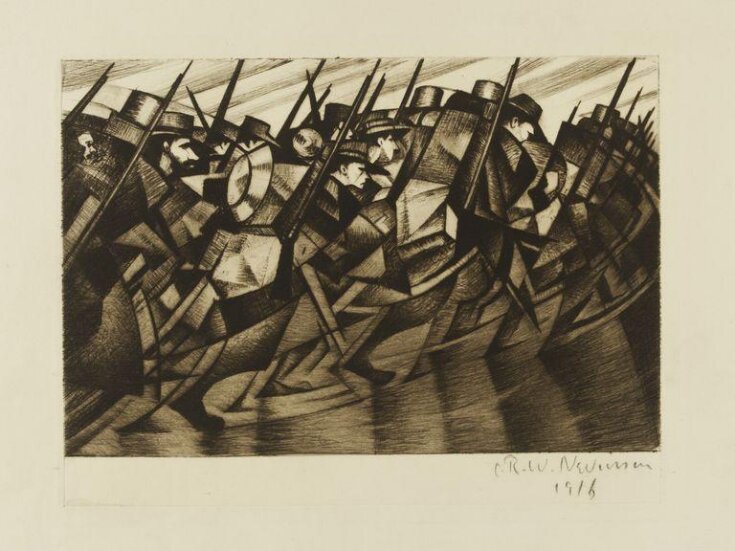 |
| Returning to the Trenches (1916) Christopher Richard Wynne Nevinson (English, 1889-1946) Etching and drypoint 13.3 x 20.1 cm. Victoria & Albert Museum |
Tuesday, March 28, 2023
Undue Fulfillment* by Kathleen Coyle
 |
| New York : William Morrow & Co., 1934 |
"It is not a crime to be a poet."
"No ... it places one on a plane where crime is so sublimated that it has another name."
In the vein of Birabeau's Revelation (1930), Undue Fulfillment is focused on a mother dealing with her son's relationship with another man. Although in this instance we hear from the son, the primary focus of the action is on the mother and her thoughts and feelings about her adult son's life and whether she has been successful at raising him.
Agatha's late husband served in World War I and having struggled since his years of service committed suicide while their son Lawrence was still young. As Lawrence grew up, Agatha held him close—too close she decided. For fear that he would not be able to disengage from his relationship with his mother enough to find a wife, Agatha returns to the convent in Ireland where she grew up, leaving Lawrence their home in Paris.
Upon hearing that Lawrence's relationship with Lena has ended, Agatha travels to Paris in hopes of bringing the two back together. Upon meeting with Lena, Agatha learns the reason for the split—Lawrence's new close relationship with Cesar Brak, a poet from Lawrence's parent's generation. While the relationship is not labeled as gay or homosexual, it is clear from what is said (and what is not said) that the relationship is sexual.
Structured around Agatha's connection to the convent and her brother Owen being a monk, there is a strong religious morality to the story. Lawrence's father who committed suicide was named Judas and appears to serve as a symbol of betrayal of his wife and child. This is juxtaposed with Cesar Brak and his generation having served in the war which was so devastating that it is hard to reconcile with the existence of any god. This is a philosophical novel about the nature of motherhood and how we reconcile our spiritual life with the challenges of being human in an ugly world.
* Also published under the title Undue Fulfilment by Ivor Nicholson & Watson Ltd., London (1935).
Bibliographies & Ratings: Cory (IV); Garde (P 50 *); Mattachine Review (IV); Young (839)
Friday, August 12, 2022
Conflict by Christopher Richard Wynne Nevinson
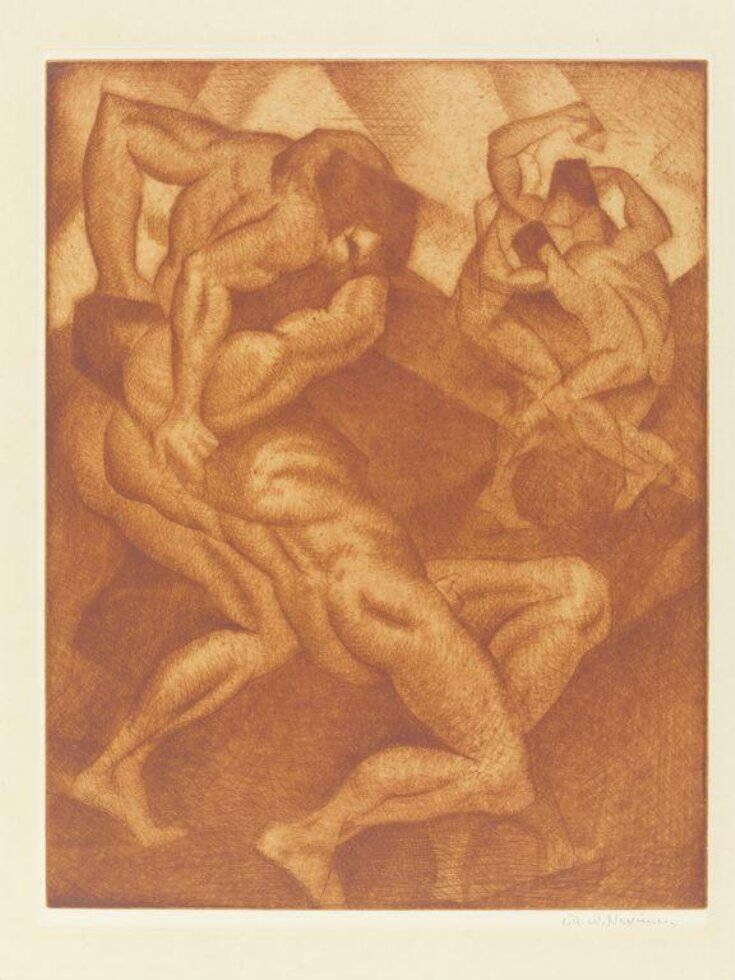 |
| Conflict (c.1926-27) Christopher Richard Wynne Nevinson (English, 1889-1946) Drypoint, printed in red 34.9 x 26.1 cm. Victoria & Albert Museum |
Sunday, August 7, 2022
Behind the Mirror by Robin Maugham
 |
| London : Longmans, 1955 Jacket design: John Minton |
Although it covers a significant amount of land, the fictional Aruna feels like a small town where rumors fly and everyone believes they know what everyone else is doing. Hartleigh is ostracized by the other residents for what they perceive as an inappropriate relationship with the young man, Bill Wayne, who lives with him. The colonists see the local residents as servants, not as equals so when Hartleigh moves an African girl into his home it creates another set of concerns for them.
While David negotiates permission from Hartleigh for the film, rumors are confirmed and secrets are revealed, endangering everyone. Hartleigh eventually reveals the truth of his relationship with Daphne Moore and their falling out, upending everything David thought he knew.
Bibliographies & Ratings: Cory (III); Garde (OTP, **); Mattachine Review (III); Young (2559/2560)
Tuesday, May 31, 2022
Matelot accoudé by Frans Masreel
%20Matelot%20accoude%CC%81,%201929.jpg "Matelot accoudé (1929) Frans Masreel (Flemish, 1889-1972) Oil on canvas 100 x 81 cm") |
| Matelot accoudé (1929) Frans Masreel (Flemish, 1889-1972) Oil on canvas 100 x 81 cm |
Wednesday, May 18, 2022
Aubade by Kenneth Martin
 |
| London : Chapman & Hall, 1957 |
One day, the young man Paul has named Gary (we later find that his name is John Knight) enters the tobacco shop. Paul had noticed him in church sometime earlier and had thought about what it might be like to be friends with him. Those overwhelming feelings of wanting to spend time with him initially go unclassified, but when they do start spending time together it begins to be clear there is mutual feeling and also what those feelings mean. The battle between one's own feelings and desires versus what one's parents or society expects is ever present as is a pervasive loneliness.
The writing is straightforward, almost blunt. It is easy to judge the authorial skill based on the author's age. To do so, though, would be unfair. The straightforward style is in keeping with Paul's desire to keep people at a distance. Many of the things he says are harsh and in many ways they serve to insure that he will remain lonely. He even says at one point that there is joy in misery. Early on in the novel, the author uses the poem, Black Marigolds, foreshadowing the feelings of sadness related to remembering a first love. Later in the novel, Paul says he "want[s] to remember Gary, and be sad, always."
Black Marigolds is a poem originally written in Sanskrit a portion of which appeared in John Steinbeck's Cannery Row.
Bibliographies & Ratings: Cory (IV); Garde (Primary, **); Mattachine Review (IV); Young (2539,*)
Bibliographies & Ratings II: Gunn (British 59a)
Thursday, April 21, 2022
Playwright Christopher Adams to Adapt Screenplay for Undiscovered LGBTQ Classic ‘Finistère’
 |
| Christopher Adams |
Playwright Christopher Adams to Adapt Screenplay for Undiscovered LGBTQ Classic ‘Finistère’
By Matt Donnelly
Variety : April 20, 2022 12:52pm PT
"Playwright Christopher Adams has been tapped to pen a screenplay based on the novel “Finistère.” While not widely known, the novel is a groundbreaking early tale of a gay man who falls in love with his tennis instructor at a French boarding school in the 1920s. It was written by Fritz Peters, whose entire catalogue was recently acquired by Hirsch Giovanni Entertainment. ... Adams is a noted English playwright who recently adapted the limited series “Aubade” for FilmNation. That series is based on a controversial 1957 queer Northern Irish novel [by Kenneth Martin]."
Tuesday, April 19, 2022
David by Eric Gill
 |
| David (1926) Eric Gill (English, 1882-1940) Intaglio print on paper 111 x 70 mm The Tate |
Sunday, April 10, 2022
Leopard in the Grass by Desmond Stewart
 |
| London : Euphorion, 1951 |
John Stirling, a young British archaeologist has arrived in Cyropolis with the intention of working for the local government on archaeological digs. The locals however, think of an archaeologist as the thinnest euphemism for British agent.
John meets Sophie Abbas, a Jewish divorcée returning home from the United States and they quickly fall into a sexual relationship. While Sophie is looking for a relationship, John seems to enjoy the sex for what it is but isn't interested in attachment. Instead, he often thinks of the relationships he had with other boys during his school days.
Owing to Britain's former colonization of the area, British citizens living in Cyropolis continue to hang together within their own enclave and within their own clubs. It becomes clear to John that he is expected to follow along.
When John finds himself in the middle of a political demonstration on the streets of Cyropolis, he is rescued by a young local and brought to his employer's car. John becomes friends with Q, the gay British artist who saved him. Q hasn't joined with the others in their clubs and has been ostracized because they believe he has 'gone native.' To be clear, it isn't the fact that Q is gay that is a problem for the other British citizens, for there are others who are as well, but it's his embrace of the local culture that seems to be the issue.
When Nimr, a Bedouin man who Q took in as a child (and seems to have had a sexual relationship with), returns after having been dismissed by Q in favor of a younger choice, Q, Sophie, and John find themselves in the middle of a drama that is both personal and illuminates the terrible consequences of colonialism.
Bibliographies & Ratings: Cory (III); Garde (OTP, a**); Mattachine Review (III); Young (3645)
Bibliographies & Ratings II: Gunn (British 45a)
Monday, April 4, 2022
Jerry (Jared French) by Paul Cadmus
%201931.png "Jerry (Jared French), 1931 Paul Cadmus (American, 1904-1999) Oil on Canvas Toledo Museum of Art") |
| Jerry (Jared French), 1931 Paul Cadmus (American, 1904-1999) Oil on Canvas Toledo Museum of Art |
Saturday, March 26, 2022
Riding by H. S. Cross
 |
| New York : Fox Books, 2008 |
As mentioned in an earlier post, Riding by H.S. Cross is an early version or draft of her novel, Grievous (2019). While Grievous tightens up the story and improves the writing, some of the original structure of Riding is unfortunately lost. The major headings of Lent, Easter, St. Stephen's (appearing at Trinity in Grievous), Summer, Michaelmas, and Christmas remain. The individual chapter titles have been dropped in favor of simple numbering. A nod to early boy's school fiction, the chapter titles suggest what is to happen in each chapter. Many early boy's school novels were originally issued serially in publications directed to school age boys and the individual chapter titles may be an artifact of this publication process.
Below is the original table of contents from Riding. Grievous, has 57 chapters in six sections. Riding also has six sections but is comprised of 95 chapters and issued in two volumes.
Riding : a novel, volume 1
ISBN: 978-0-6152-1366-8 — Fox Books 2008, 513p
Lent
They Longed for the Sheltering Sky
There Was a Book
Mr. Grieves Is Not Amused
Something to Remember
She Envied Her Own Pens
The Propagation of Knowledge
Cartomania
Forgive Our Foolish Ways
Eels, the West Wind, and People Like Us
The Boredom Is No Longer Exquisite
Why Does He Deserve It?
Night
Morning
Friend Indeed
Caveats
The Trial
Perfect Gifts
Triangulation
The Tower
The Doctor is In
That Hideous Recognition
The Chair Loft
Souls of Men
Easter
Passage
Curses
London
Zapped
The Channel
The Key
Paris
Mazes, Continental and Otherwise
Drought
The Weapons of Pacifists
Quicksand, With Beacons
St. Stephen's
Return
Winds of Change
I Write This Not to the Many, but to You
Code That Sets the Miles at Naught
Stratigraphy
Touch
Heartbeat, Heartburn, Heart Attack, Heartbreak
Pursuits, Intellectual and Otherwise
The Persistence of Memory
Orders of Magnitude
Patron's Day
The Exigencies of Time
The Cure
In Which the Geomaniac Ventures, and Is Lost
Progress
Pioneers
Riding : a novel, volume 2
ISBN: 978-0-615-26248-2 — Fox Books 2008, 550p
Summer
To Wake, as if From Dreaming
Irresistible
Messages, Direct and Indirect
The Quick and the Dead
Nothing Shall Be Impossible
The Lady From the Sea
Michaelmas
Rank by Rank
A World Gone Mad
Something in Their Midst
Hounded by His Adversary
Ely
Lamentation of Swans
Venture
Chariot of Fire
Experiences
The Contract
Hypnos and Son
Crime and Punishment
The Passage of Time Vexed Them
The Encircling Gloom
Orders of Magnitude, II
The Pillar of the Cloud
The World as We Know It
The World as It Has Known Itself
This Howling Insanity
Exeat
An Approximation of the Moon
Night, II
Another Gift
The Ninety-Second Day of Michaelmas Term
Keeper of a Hundred Secrets
A Kind of Mercy
The Coming Storm
Ice
As Bad as All That
What Girls Are Made Of
The Most Brutal of Punishments
Unfamiliar Sun
Christmas Tea
Christmas
The Future
The Present
The Past
Like the Wildness of the Sea
The Winters of Your Grief
And Christmas Comes Once More
Monday, February 28, 2022
Swimmer by John La Farge
 |
| Swimmer (1866) John La Farge (American, 1835-1910) Watercolor 32.5 × 28.2 cm (12 13/16 × 11 1/8 in.) Yale University Art Gallery |
Friday, February 25, 2022
Fritz Peters, Early LGBTQ Literary Icon, Coming to Screens and Bookshelves in New Rights Deal
 |
| Fritz Peters c.1965 Collection of Edward Field |
Fritz Peters, Early LGBTQ Literary Icon, Coming to Screens and Bookshelves in New Rights Deal
By Matt Donnelly
Variety : February 23, 2022 12:32pm PT
"Peters’ most notable work was his second novel, “Finistére.” It is regarded as one of the first gay-centered novels to come out of the era not concerning WWII. It details the adolescence and homosexual encounters of its main character and is said to be inspired by Peters’ own life. Acclaimed by Vidal, it received an unheard of first-run printing of 350,000 copies, according to his estate. It is also the first up for adaptation, with a screenwriter to be announced imminently."
Sunday, February 20, 2022
Finistère by Fritz Peters
 |
| New York: Farrar, Straus, 1951 |
Peters' second novel focuses on the tumultuous adolescence of Matthew Cameron. As Gore Vidal noted in his much quoted book review in The Saturday Review of Literature (Murder of Innocence, v.34:no.8, p.13, February 24, 1951), the first third of this book lays out the many betrayals experienced by young Matthew. The middle third lays out the story of Matthew's relationship with Michel, and the final third follows the rapid disintegration of Matthew's world.
Tobias Schneebaum (1922-2005), in his introduction to the 2003 re-release of his 1979 work Wild Man (University of Wisconsin Press), discusses the reception of his early work's gay themes and the ways in which authors, such as Gore Vidal and Fritz Peters conformed to expectations of publishers of the time. In 1965, a new edition of the 1948 novel The City and the Pillar was released "in order to return to it the strength, the temperament and the animus that Vidal had wanted in the first place." Schneebaum further states that Fritz Peters was forced by his editor to change his original happy ending for Finistère to "an ending that was tragic, to conform with contemporary ideas concerning what interested the public and what was obscene."
It is the summer of 1927. Thirteen-year-old Matthew's parents are divorcing and he and his mother are relocating to Paris. She has decided Matthew is too attached to her and to Scott Fletcher, a close friend of the family so Matthew is to be enrolled in the boarding school, St. Croix École des Garçons. Soon after Matthew's arrival at the school, André, a classmate, shares some dirty pictures with him and they become friends. The headmaster approves of them sharing a room and before long they are having a sexual relationship—a relationship about which Matthew feels quite guilty.
While with his family at the Christmas holiday, Matthew meets his mother's new 'friend', Paul Dumesnil. While Paul makes an effort to include him in conversations and activities, Matthew now feels like an outsider. As a condition of his parents divorce, Matthew isn't permitted to see his father until he reaches age 16. His father effectively disappeared from his life, and now he feels he is losing his mother as well.
By the following fall 1928, his mother marries Paul. Scott, whom Matthew has idolized for years, has become engaged to Françoise. Scott, who had always been available to him is now focused on his relationship with Françoise and seems to have no time for him. Françoise seems to be the only adult who recognizes Matthew's attachment to Scott for what it is.
After a summer with his family, Matthew returns to school in the fall of 1929, to discover that André has gone, having moved to a different school. Alone and without support from any of his relationships, he feels lost. Michel Garnier, a new athletic coach, has joined the school and upon the boys' first outing for a swim in the Seine, Matthew swims too far and seems to give in to the current pulling him under. The relationship with Michel begins after he saves the drowning Matthew and helps to nurse him back to health. Their relationship brings Matthew back to life, feeling true love for the first time without all of the guilt he felt about his relationship with André. However, Matthew is innocent and this idealized first love can't insulate him from the cruelty of the world or of the adults in his life.
It is no surprise that the ending of a gay novel from this time is likely to end tragically—most (but not all) did. As might be surmised by the many editions over the years, Finistère was popular among gay men despite the ending. The central message of the novel isn't that gay people are bad, or in this case, the problem isn't that Matthew is gay. The problem is that the adults in Matthew's life are incapable of supporting him.
![Finistere by Fritz Peters ; TOP ROW FROM LEFT TO RIGHT: [1] London : Victor Gollanz, 1951 [2] New York : Signet/NAL, 1952 [3] Fin de la Tierra, Spanish translation by A. S. Glanz, Buenos Aires : Editorial Dintel, 1953 [4] The World at Twilight, New York : Lancer Books, 1964 [5] New York : Lancer Books, 1966 [6] London : Victor Gollanz, 1966. ⸻ BOTTOM ROW FROM LEFT TO RIGHT: [7] New York : Lancer Books, 1968 [8] London : Panther, 1969 [9] Los Angeles : Seeker Press, 1985 [10] New York : Plume/NAL, 1986 [11] Vancouver : Arsenal Pulp Press, 2006.](https://blogger.googleusercontent.com/img/a/AVvXsEj28t2kAu1uP3Mx13EwoLZ0rCmtkxdUq0cu-UVUiRtbWdzRGaWy-E52G2f4x5ZBUH-ST5a2oW4-bzcOxEG15AEQ0q7ostfeH_UaR5qB8pSjpXi7L67GdrNHs9IUwFjage5y4VZMfkZBg-5dCd9ljoLMbqTSs0Fhwsjrm7MbRLMyv4XVYSo4TUx0zKte=w640-h325 "Finistere by Fritz Peters ; TOP ROW FROM LEFT TO RIGHT: [1] London : Victor Gollanz, 1951 [2] New York : Signet/NAL, 1952 [3] Fin de la Tierra, Spanish translation by A. S. Glanz, Buenos Aires : Editorial Dintel, 1953 [4] The World at Twilight, New York : Lancer Books, 1964 [5] New York : Lancer Books, 1966 [6] London : Victor Gollanz, 1966. ⸻ BOTTOM ROW FROM LEFT TO RIGHT: [7] New York : Lancer Books, 1968 [8] London : Panther, 1969 [9] Los Angeles : Seeker Press, 1985 [10] New York : Plume/NAL, 1986 [11] Vancouver : Arsenal Pulp Press, 2006.") |
| TOP ROW FROM LEFT TO RIGHT: [1] London : Victor Gollanz, 1951 [2] New York : Signet/NAL, 1952 [3] Fin de la Tierra, Spanish translation by A. S. Glanz, Buenos Aires : Editorial Dintel, 1953 [4] The World at Twilight, New York : Lancer Books, 1964 [5] New York : Lancer Books, 1966 [6] London : Victor Gollanz, 1966. ⸻ BOTTOM ROW FROM LEFT TO RIGHT: [7] New York : Lancer Books, 1968 [8] London : Panther, 1969 [9] Los Angeles : Seeker Press, 1985 [10] New York : Plume/NAL, 1986 [11] Vancouver : Arsenal Pulp Press, 2006. |
Matthew's Happy Ending
![Fritz Peters correcting galley proofs of his second novel, Finistère November 27, 1950 [cat 3119-0007] Private Collection](https://blogger.googleusercontent.com/img/a/AVvXsEi7Da54P20PmDNTxjla21DeD-x54yQNrY1oqODA-f-1d1TsB7V2c2C6Ebz_0PGir1A0tBGa1kXcv0BPpLE6nf7kgaSswl7PADNKTsRLNyfBDQPcQ2IaBxS7yNMj0eKvQJG3-YWeCM06_8pCKFgUPDXx_UMFgZBnmtqrlC8klxqq-7CmjRJRnwGEipMA=w320-h252 "Fritz Peters correcting galley proofs of his second novel, Finistère November 27, 1950 [cat 3119-0007] Private Collection") |
| Fritz Peters correcting galley proofs of his second novel, Finistère November 27, 1950 [cat 3119-0007] Private Collection |
Columbia University Libraries announced in the Our Growing Collections column in Columbia Library Columns (v.13:no.2 1964:February, p.55) that "Mr. Fritz Peters has presented the manuscript of his novel, Finistère, published in New York in 1951." Interestingly it was listed under the section for medical library gifts. It is now housed in Columbia's Rare Book and Manuscript Library within the collection, General Manuscripts, 1789-2013. The type-written manuscript with minor changes in ink follows the published work, including the tragic ending.
If there was an original happy ending to Finistère, it appears to have been lost to history. What might Matthew's life have looked like, had Fritz Peters been free of the cultural and moral restrictions of mid-twentieth century American publishing?
Bibliographies & Ratings: Cory (IV); Garde (Primary, **); Mattachine Review (IV); Young (3019/3020,*)
Bibliographies & Ratings II: Austen (174); Gunn (American 54a); Levin (121)
Subscribe to:
Posts (Atom)