Showing posts with label 1959. Show all posts

Wednesday, June 17, 2020

Malcolm by James Purdy

Malcolm by James Purdy ; New York : Farrar, Straus & Cudahy, 1959
New York : Farrar, Straus & Cudahy, 1959
James Purdy's Malcolm is both a contemporary comedy of manners and a satire of class and its trappings. Malcolm is a beautiful 15-year-old who spends his days on a bench outside the hotel where he lives. He is an innocent whose father disappeared nearly a year ago, and yet he still waits for his return. Short on funds, he's unsure what he will do.

Mr. Cox, an astrologer, is drawn to Malcolm and sees it as his responsibility to move him along from spending his days on this bench. In fact, he sees it as his responsibility to tell everyone what he thinks they should do; after all, it's in the stars. Cox connects Malcolm to a series of characters by providing him the addresses of his friends.

Malcolm meets 'little man', Kermit, a midget artist who is supported by his much larger wife Laureen, magnate Girard Girard and his wife Madame Girard for whom money is no object, artist Eloisa and her ex-con husband Jerome. They all struggle to posses Malcolm, to have the power to 'mature him'. His youth and inexperience, and frankly his lack of education, make for a great deal of comedy through misunderstanding. What follows is a pitched battle for ownership of Malcolm's youth and beauty, while highlighting the class distinctions among the players.

All of the characters are drawn to Malcolm. Some appear to want to protect his youth and innocence, while others seem intent on destroying it. While handled subtly, the suggestion that some of the male characters have a sexual interest in Malcolm as well as in one another appears throughout the work. This sexual fluidity is a hallmark of Purdy's characters and writing.

Written in a theatrical style, it's easy to see why it was re-cast as a play by Edward Albee in 1966.


Bibliographies & Ratings: Young (3150*)

Saturday, August 6, 2016

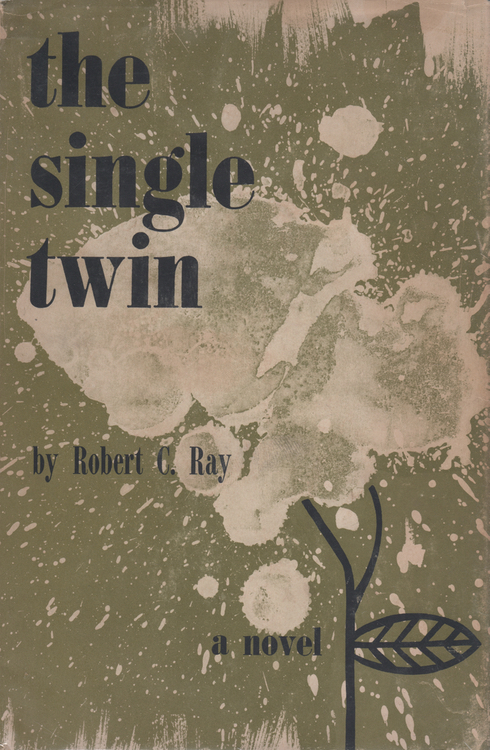
The Single Twin by Robert C. Ray

The Single Twin by Robert C. Ray ; New York : Comet Press, 1959
New York : Comet Press, 1959
The novel opens on a wintry Chicago night in the late 1950s outside an art gallery on Michigan Avenue. The owner is always afraid that he has forgotten to lock the door upon leaving. On this night he has and a stranger slowly takes in the images on the walls and comes to rest on the one titled, The Single Twin. The artist receives a letter from a high school friend and the novel then shifts into a lengthy flashback beginning in the spring of 1940 and continuing through the United States' entry into World War II.

Three students nearing graduation in Summitville, IN are in a love triangle. Artistic, Sam, whose parents died when he was young, lives with his grandmother and is gay. (It's his gallery show that opens the novel.) Velma lives with her mother, with whom she battles on a daily basis. Her father abandoned them when she was young. Velma's boyfriend, Ramon is a gypsy from the wrong side of the tracks and also has a very close relationship with Sam. Ramon wants to marry Velma to please his father and Velma needs to get married because she is pregnant by another man. After the wedding, this secret quickly causes the rapid destruction of the marriage.

Robert C. Ray (b. 1926)  Author of The Single Twin
Robert C. Ray (b. 1926)
Author of The Single Twin
Written very much in the style of sensational novels of the 1950s, it has a bit of everything: a lounge singer, secret pregnancies, interracial relationships, abandoned babies, a hermaphrodite, prostitution, a gay man, a mental hospital, alcoholism and incest. The storylines resolve a little too neatly, especially given the geographic coverage (small-town Indiana, St. Louis, Louisville, Louisiana and Europe during the war years). Even if it is a little too perfect, it's still a page turner. The Single Twin was either a very small print run or was published by what used to be termed a vanity press. Only four libraries whose holdings are in WorldCat have a copy, and other than the copy I read, there do not appear to be any copies for sale online.

Robert C. Ray was born in Elwood, Indiana in 1926, attended the John Herron  Art Institute after high school and is a professional painter and an interior decorator.

Saturday, April 16, 2016

The Feathers of Death by Simon Raven

The Feathers of Death by Simon Raven, London : Anthony Blond, 1959
London : Anthony Blond, 1959
The trouble began the moment Lieutenant Alastair Lynch laid eyes on 18-year-old Drummer, Malcolm Harley, who was participating in a boxing match aboard ship. After the first round, "[h]e went back to his corner flushed and quivering, though apparently not badly damaged. When he sat down on the stool, he leaned right back against the corner pad and stretched his legs out in front of him, so that, from where I was sitting, I could see right up his shorts to his groin." (p.12)

The ship carrying the 121st Mounted Infantry (also known as Martock's Foot) lands at the fictional port of Eirene. After settling in, Harley is discovered to be drunk during the guard of honour for the General's departure. Lynch defends him and agrees to take him into his troop (and under his wing). Privately, the other officers are confused why Lynch has stood up for this boy and greatly concerned about just what sort of feelings Lynch has for him.

In a conversation with one of his fellow officers, Michael Byrt, Lynch confirms his feelings for Harley. When Byrt suggests that he is meant to have grown up since leaving school, Lynch replies, "Not a very clever observation. Some people 'grow up', as you put it, much later than others. Some never grow up at all. Or perhaps growing-up has nothing whatever to do with it." (p.106)

Tasked with patrolling English settlements to protect them from Karioukeya's Brigade, a group of natives actively fighting the colonization of their lands, Lynch's troops come under attack. During the fighting, Lynch shoots Harley and is brought before the court martial to determine whether he is guilty of murder. The relationship between Lynch and Harley, known among the other men, becomes the focus of the proceedings.

Rules about fraternization with locals and the prohibition of the use of prostitutes, creates a closed all-male environment that feels more like a boarding school than the modern military, maybe not surprising since the officers are barely out of school. The author reinforces this with the use of Greek place names as well as references to classic Greek military campaigns.


Bibliographies & Ratings: Young (3212, *)