Showing posts with label 1958. Show all posts

Monday, August 17, 2020

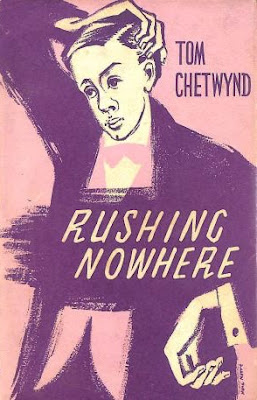
Rushing Nowhere by Tom Chetwynd


Rushing Nowhere by Tom Chetwynd ; London : Anthony Blond, 1958
London : Anthony Blond, 1958
Rushing Nowhere, a coming of age novel set in the early 1950s, is the story of Guy Wentworth from the time he is in a Catholic preparatory school through the beginning of his military service. He struggles to find his way, never quite satisfied with anyone he meets or anything he might decide to do. 

While in prep school, Guy befriends Fotheringay, a boy who struggles with the typical boarding school issues. After Guy is warned off of a regular interaction he has been having with one of the housemasters, he suddenly tells Fotheringay that they shouldn't hang out all of the time. There is a suggestion that these relationships might turn into something that is too close or inappropriate. Fotheringay is crushed by the hurtful way that Guy cuts things off and shortly afterward he is found drowned in a bathtub. Guy struggles from this point forward, not knowing wether the death was an accident or if their final words to one another led to the boy's death. 

This critical moment seems to have had a major affect on Guy's life. While he seeks out relationships with women and other boys (and at one point befriends an older gay man), he consistently stops short when it's clear that everyone has their own agenda. He can't find the organic closeness he had with Fotheringay with any of these people. This inability to connect with others also manifests itself in his inability to stick with any plan for a career or work. His adventures in trying to find himself traveling through Europe come to a close with his being called up by the army, a trap from which he won't be able to escape.


Bibliographies & Ratings: Cory (III); Garde (OTP, b*); Young (651)


Sunday, April 5, 2020

Nature's Way by Herman Wouk

New York : Doubleday, 1958
Herman Wouk is most known for his military novels set during World War II; 1951's The Caine Mutiny, 1971's The Winds of War and 1978's War and Remembrance. While less remembered, he also published both plays and comic works.

Nature's Way is a comic play in two acts that premiered October 16, 1957 at the Coronet Theatre in New York.  Newlyweds Billy and Maggie Turk are living extravagantly off of the success of Billy's first musical and they are expecting their first child. Everyone seems to want a piece of their success. When their accountant announces a miscalculation in their taxes and that they will owe an additional $50,000, they don't know how they will pay it.

Vivian Voles, Billy's creative partner, suggests he and Billy spend a few months in Venice writing the next big show. With the right investors, Billy can get the money to pay off the tax debt. Maggie isn't a fan of Vivian, nor of his plan. It's clear that Maggie believes that Vivian is trying to break the couple apart. What isn't clear is whether she believes his motive is his own romantic interest in Billy.

Set in the theater world, there is both acknowledgement and a sense that we don't talk about Vivian's sexuality. The mild comments come from Maggie and her mother, Mrs. Fawcett, who aren't from that world. The humor in the play is even handed and doesn't make a clown of Vivian's character. In fact the humor is at everyones expense.

Bibliographies & Ratings: Cory (II); Garde (OTP b*); Mattachine Review (III); Young (4235)


Thursday, July 13, 2017

Mask of Flesh by Maxence van der Meersch

Mask of Flesh by Maxence van der Meersch London : William Kimber, 1960 Translated from the French by Mervyn Savill
London : William Kimber, 1960
Translated from the French by Mervyn Savill
Although Masque de Chair was published in 1958 (seven years after the author's death), its origins date back to the height of his career in the mid 1940s. The controversial novel presents a Flemish man attempting to reconcile his catholic faith and his sexuality by sharing a series of reminiscences beginning in early childhood. It is a challenging work that has been criticized for advocating adherence to catholic doctrine over living a full life as a gay man.

Emmanuel Ghelens, born in the years before WWI, obsesses over the effect of having had the prototypical controlling, 'masculine' mother has had on his life. During the war, his parents send him to boarding school. He describes his introduction to sex and his desire to create a lasting bond with the other boys. For them, it was simply physical. At the age of 18, he was picked up by an older man in Antwerp. Although he describes being disgusted with himself after the experience, he also began to make the connection in his own mind of his behavior and that of female prostitutes. They also (unwittingly) are searching for a little tenderness ... each time surrendering a little piece of their heart.

He soon begins to describe himself as a depraved monster or as having a monster living inside him. "It had made me a prisoner, a slave of the flesh." (p.39) After consulting a priest who told him that he was damned, he decides to live in solitude to avoid corruption. He knows that he will be open to robbery and blackmail if he doesn't.

A short time later, he meets Seddik, an Algerian man who had turned to prostitution in order to survive. Seddik was really looking for a friend and had found one in Emmanuel. While traveling, Emmanuel falls ill and when he is finally able to return, Seddik has disappeared. This is a huge loss for Emmanuel. Seddik was a prospect for hope and possible redemption. He had found love ... and had now lost it. He was now a prisoner again.

For a digitized archival collection of material related to the author (including correspondence regarding the manuscript for Masque de Chair), visit Archives de Maxence van der Meersch at Bibliothèque Numérique de Roubaix (in French).


Bibliographies & Ratings: Young (2641*)

Monday, October 12, 2015

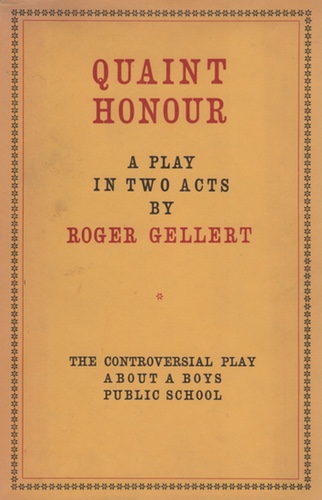
Quaint Honour : a play in three acts by Roger Gellert (John Edwin Holmstrom)

London : Secker & Warburg, 1958
(jacket incorrectly states two acts)

Quaint Honour's setting is an unnamed public school during the late 1950s. House Prefect, Tully, is challenged by his fag, Turner, to seduce another junior, Hamilton. Taking up the challenge, Tully and Hamilton are soon an item. Just as quickly, they are found out by Head of House, Park who reports them to Housemaster, Hallowes. Tully will of course be sacked, but what is Hamilton's fate?

Originally produced at the Arts Theatre in London, it premiered on May 1, 1958. This private club was beyond the reach of Lord Chamberlain's powers of censorship.

Produced by Frank Dunlop and with settings by Paul Mayo, the original cast included John Richmond as Robert Hallowes, Philip Waddilove as M. L. Park, John Charlesworth as J. V. H. Tully, Roderick McLaren as R. R. Turner and Michael Caridia as T. A. B. Hamilton.


Bibliographies & Ratings: Garde (Primary, **); Young (1380)

Michael Caridia as Hamilton and John Charlesworth as Tully
in The Arts Theatre production of Quaint Honour, 1958.