Showing posts with label WWI. Show all posts

Wednesday, April 26, 2023

In Memoriam by Alice Winn

In Memoriam by Alice Winn ; New York : Knopf, 2023
New York : Knopf, 2023
It's 1914 and Henry Gaunt and Sydney Ellwood, still in boarding school, follow the news from the war with excitement, including the heroic deaths of their friends. Gaunt, half German, enlists as a way to limit the anti-German sentiment he and his family might experience and to leave behind the feelings for Ellwood that he can't acknowledge, much less act upon. Ellwood, also silently pining for Gaunt soon follows.

The author uses a variety of forms, including letters and issues of the school newspaper, The Preshutian, to follow Gaunt, Ellwood and their friends through the actions of the war, including the horrors of the Somme and the deaths of many. 

Boarding school novels set in the 1920s often discuss the 'Old Boys'—those former students who fought in World War I and sometimes return for cricket matches against the current students.  Winn has flipped this by constructing a boarding school novel that highlights the youth and excitement of the students but then follows them into the war. What is glorified in bravery by the school and its students is a horror laid bare through their experience of the war. 


Wednesday, April 12, 2023

Tuesday, March 28, 2023

Undue Fulfillment* by Kathleen Coyle

Undue Fulfillment by Kathleen Coyle ; New York : William Morrow & Co., 1934
New York : William Morrow & Co., 1934

"It is not a crime to be a poet."

"No ... it places one on a plane where crime is so sublimated that it has another name."


In the vein of Birabeau's Revelation (1930), Undue Fulfillment is focused on a mother dealing with her son's relationship with another man. Although in this instance we hear from the son, the primary focus of the action is on the mother and her thoughts and feelings about her adult son's life and whether she has been successful at raising him.

Agatha's late husband served in World War I and having struggled since his years of service committed suicide while their son Lawrence was still young. As Lawrence grew up, Agatha held him close—too close she decided. For  fear that he would not be able to disengage from his relationship with his mother enough to find a wife, Agatha returns to the convent in Ireland where she grew up, leaving Lawrence their home in Paris.

Upon hearing that Lawrence's relationship with Lena has ended, Agatha travels to Paris in hopes of bringing the two back together. Upon meeting with Lena, Agatha learns the reason for the split—Lawrence's new close relationship with Cesar Brak, a poet from Lawrence's parent's generation. While the relationship is not labeled as gay or homosexual, it is clear from what is said (and what is not said) that the relationship is sexual.

Structured around Agatha's connection to the convent and her brother Owen being a monk, there is a strong religious morality to the story. Lawrence's father who committed suicide was named Judas and appears to serve as a symbol of betrayal of his wife and child. This is juxtaposed with Cesar Brak and his generation having served in the war which was so devastating that it is hard to reconcile with the existence of any god. This is a philosophical novel about the nature of motherhood and how we reconcile our spiritual life with the challenges of being human in an ugly world. 

* Also published under the title Undue Fulfilment by Ivor Nicholson & Watson Ltd., London (1935).


Bibliographies & Ratings: Cory (IV); Garde (P 50 *); Mattachine Review (IV); Young (839)


Tuesday, January 11, 2022

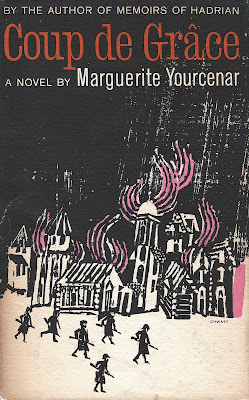
Coup de Grâce by Marguerite Yourcenar

Coup de Grâce by Marguerite Yourcenar ; New York : Farrar, Straus & Cudahy, 1957
New York : Farrar, Straus & Cudahy, 1957

Not released in English until 1957—after the success of Memoirs of Hadrian—the original French edition of Coup de Grâce had been published in 1939. The novel opens with our main character Erick von Lhomond, recently injured during the Spanish Civil War, returning to Germany by way of Italy. Among the other mercenaries, he begins to tell his story of war, going all the way back to the Bolshevik Revolution.

Although he had trained to join the German military during World War I, he was still too young to fight before the war ended. His father, having died at Verdun, left the family in debt. Between his need to fight and his family's need for money, he decides to join German forces fighting the Bolsheviks in Kurland (Courland) in what is modern-day Latvia. Erick had spent the happiest times of his youth there with relatives in the home of the Count of Reval, which now served as a barracks for the fighters. Erick's childhood friend Conrad fights alongside him and Conrad's sister, Sophie helps to care for all of the soldiers. 

Only a few years have passed since the happiness of his youth and Erick easily reconnects with Conrad. What he doesn't expect is the more mature attentions of Sophie. He continuously deflects her attentions, which become quite overt. He seems unwilling to be honest about the reasons for his dismissal of her advances—his feelings for Conrad. His youth means that he doesn't really know what he feels. He refers to his 'indispensable vice' and how it 'is much less the love for boys, than for solitude.' In the end, his time in that house, both as a child, and as a soldier was never about games or war, it was always about Conrad.

Told only from Erick's perspective, we hear about his inner feelings and only the perceived feelings of those around him. His tendency toward solitude, largely brought on by the uncertainty of a future in war-worn Europe, kept him from sharing his feelings with those around him. It's a heartbreaking story of lost youth and lost love.


Bibliographies & Ratings: Cory (III); Garde (OTP, c/d*); Mattachine Review (III); Young (4273)


Friday, October 22, 2021

The Magician by Colm Toibin

The Magician by Colm Toibin ; New York : Scribner, 2021
New York : Scribner, 2021
Like The Master before it, Toibin has centered his novel on an important literary figure. The Master gave us Henry James; The Magician presents Thomas Mann.

Opening in 1891 in Lübeck, Germany with a 16 year old Thomas, spanning sixty years, and ending in 1950 Los Angeles, Toibin presents Thomas' life in detail. Thomas publishes Buddenbrooks and Death in Venice to much acclaim, before World War I. The interwar years are complicated for Thomas with both his brother Heinrich and his children Klaus and Erika becoming quite vocal politically. With the rise of Hitler and the Mann's exile to Switzerland, Thomas doesn't feel that he can speak out against the Nazis—in part because he wants his books to remain in print in Germany, which he still considers home. His decision to remain mostly silent allowed him to continue to sell his works and support his family in an increasingly polarized world.

A particularly strong moment in the novel happens around Thomas' request that his son who is still in Germany retrieve his journals from the safe in their home and send them to Thomas in Switzerland. For a period, the journals are lost and Thomas' concern manifests itself in a flashback based on an entry in the journals that makes clear Thomas' homosexuality. This section provides the strongest sense of what Thomas Mann may have been feeling, while the rest of the novel seems to be solely focused on what happened next.

While many reviewers contend that the novel is about Thomas Mann's secret sexuality, it actually plays a minor role. The focus of the novel is the day-to-day life of Thomas and his family, how they survive the social and political upheaval of the time, and how Thomas' decisions about what to say publicly (or not say publicly) allowed the family to survive World War II. 

Stylistically, The Magician is a novel, but structurally it reads like biography. In this way, I think the adherence to a linear chronological structure with chapters titled by location and year, doesn't allow the reader to learn much about Thomas Mann, the man. While reading, I wondered if a novel structured more specifically around the fear of the Nazis obtaining his journals and flashing back to various experiences through his life documented in the journals might have allowed the reader to have a sense of what Thomas felt about his own life and sexuality, or what or how he felt about his children's sexuality, three of whom would be considered part of the LGBTQ community today.


Monday, August 23, 2021

Alec by William di Canzio

Alec by William di Canzio ; New York: Farrar, Straus & Giroux, 2021
New York: Farrar, Straus & Giroux, 2021
On the occasion of the 50th anniversary of the publication of E. M. Forster's Maurice, William di Canzio gives us Alec, a novel that both enhances and expands the original story. While it isn't strictly necessary to have read Maurice to understand Alec, the decisions Di Canzio has made seem more clear having read both and frankly, readers should do themselves the favor of reading both of these excellent novels.

In Maurice, Forster tells the story of Maurice's relationship with Clive both from Maurice's and from Clive's perspectives. But when it comes to Maurice's relationship with Alec, he only provides the story from Maurice's perspective, preferencing an upper class telling. 

Di Canzio has chosen to give voice to Alec in his novel, providing a brief telling of his younger years (as Forster did for Maurice) and then telling the story of Alec and Maurice meeting and falling in love, but this time from Alec's perspective. The author has even used some direct language from Maurice in this section to create a continuity between the works. Where I think Di Canzio excels is at providing believable alternatives to what Maurice thought was happening in the original text. 

One could really be satisfied with just this much of Alec, taking the reader to the point in time where Maurice ends. Di Canzio opts, however to take us further. He creates a life for the characters that is much more uplifting than Forster's ending, much less his abandoned 1914 epilogue. He takes them into World War I, an area we know from Forster himself that he was unable or unwilling to go.

Like Maurice, Alec is a romance. Di Canzio doesn't shy away from the sex either. In the early chapters the sex scenes read a bit like Victorian erotica but they begin to be described in a more modern way as our characters and the world experience the changes that WWI brings. This is a worthy companion piece, allowing us to spend just a bit more time with these classic characters.


Saturday, March 18, 2017

A Simple Inquiry by Ernest Hemingway

Ernest Hemingway, 1918  Portrait by Ermeni Studios
Ernest Hemingway, 1918
Portrait by Ermeni Studios
A Simple Inquiry first appeared in Hemingway's second story collection, Men Without Women, published by Scribner's in 1927. Although Hemingway doesn't explicitly describe the setting for the story, it can be deduced that it takes place in Italy during World War I.

The story opens in a snow covered military hut. The major retires to his room while his adjutant, Tonani, continues to busy himself with paperwork. When Pinin, the major's orderly enters, the major calls for him. The 19-year-old Pinin enters the major's room and is questioned about his romantic life. After the major demonstrates that Tonani cannot hear their conversation through the wall, he continues to press the orderly with  additional personal questions. The major appears to be propositioning the young man but when he is gently rebuffed, he backs off. The conversation ends with the major suggesting that Pinin could return to his platoon if he wished but if he stayed he might avoid being wounded.

This story seems a bit of a departure from Hemingway's other writings which are focused on all of the trappings of masculinity. While another of his short stories includes a gay storyline (Mother of a Queen, published in the story collection Winner Take Nothing in 1933), A Simple Inquiry's straightforward telling doesn't moralize about the characters' behaviors.

In June 1918, 18-year-old Ernest Hemingway arrived in Italy to serve as an ambulance driver at the Italian Front during World War I. The genesis for this story may have come from his observations or experiences during the war.

What is commonly termed 'situational homosexuality' presents itself throughout history in all male environments (like the military). As well, Italy has a long reputation of being more permissive around issues of male same-sex activity. In fact, it was considered a normal part of adolescent sexual education, particularly in southern Italy. In 1889 the Zanardelli Code decriminalized same-sex acts in all of unified Italy. This cemented Italy's reputation among Europe's homosexuals of tolerance and enlightenment on legislating these matters.

Bibliographies & Ratings: Cory (IV); Mattachine Review (IV) ; Young (1754*)

Sunday, January 3, 2016

Goldie by Kennilworth Bruce

Goldie by Kennilworth Bruce; New York : William Goodwin, 1933
New York : William Goodwin, 1933
Of the gay novels of the 1930s, Goldie is the most elusive. Held by less than a handful of libraries (in special collections departments), one assumes that there are no more than an equal number being held by independent collectors. Some kind soul posted the image I include here on LibraryThing.

Synopses of this rare novel appear in three publications. Roger Austen's is the first and most complete in his Playing the Game: The Homosexual Novel in America (1977). James Levin's The Gay Novel in America (1991) and John Laughery's The Other Side of Silence: Men's Lives and Gay Identities: A Twentieth-Century History (1998) both rely on Austen (as I will).

A young man from the midwest, Paul Kameron, is an ace pilot with the Royal Flying Corps during World War I. Bailing out over Germany, he is 'brought out' while being held in a POW camp. After the war, he returns to New York with his lover, a furrier he met in Europe. Paul grows more comfortable with having entered 'Limbo' (his term for 'the gay life') when he discovers there are "more than four million others in the United States who dwelt in that twilight realm of sex."

Paul transforms into Goldie when he begins dying his hair. After his lover catches him with the shop janitor, he breaks it off and Goldie is left to hustle on Broadway. He later has an affair with a gangster and starts working in a gay restaurant in the Village.

Goldie's friend, Jack Shaw, has the idea to form a gay liberation club. Its first meeting takes place in the restaurant and draws six people, including Goldie. In drafting their resolution, they aim to abolish the laws in the State of New York that make 'inversion' a crime. They cite both France and Italy having both eliminated similar laws over 100 years ago. Thus, The Twilight League was born. And just as quickly it met its demise due to its members each having plans to exploit the League in different ways, up to and including running a connections service where "wolves could obtain fairies."

Laughery, in The Other Side of Silence, ends his synopsis of Goldie by asking the question "... in 1933 who knew any homosexuals who thought they had civil rights to agitate for?" George Chauncey's Gay New York: Gender, Urban Culture, and the Making of the Gay Male World 1890-1940 (1994) offers a place to start answering this question.

FROM TOP TO BOTTOM: Magnus Hirschfeld, Henry Gerber
FROM TOP TO BOTTOM: Magnus
Hirschfeld, Henry Gerber
It is accepted that the mass mobilization of American men during WWII and their exposure to more progressive attitudes about sexuality in Europe led gay men after the war to see new possibilities for their own lives, especially as they settled in New York and San Fransisco. The evidence also suggests that service members during WWI, albeit fewer of them, were also exposed to a cultural and political climate for homosexuals in both Paris and Berlin which far surpassed what they could have imagined in small-town America or even New York.

Magnus Hirschfeld founded The Wissenschaftlich-humanitäres Komitee (Scientific-Humanitarian Committee) in May 1897 to campaign for legal recognition of gay lesbian and transgender men and women and against their persecution (specifically Paragraph 175). It was the earliest gay rights group, but certainly not the only one in early 20th century Berlin. It continued its activities through 1933, when the Nazis destroyed The Institut for Sexualwissenschaft  (Institute for Sexual Sciences) which housed it's offices.

From 1920 to 1923, Henry Gerber had served with the Army of Occupation in Germany after WWI and had seen firsthand the openness of Berlin during this time and was upset about the way homosexuals were treated in the United States. In December 1924, now living in Chicago, Gerber founded The Society for Human Rights by filing a charter with the State of Illinois. Gerber chose to use the same name as was used by the german group he most closely identified with, Bund für Menschenrecht (The Society for Human Rights).

A police raid and subsequent arrests brought The Society for Human Rights abruptly to an end in the summer of 1925. Gerber's Society had concentrated  its efforts on the State of Illinois where they focused on reforming laws that criminalized homosexual acts. This sounds suspiciously similar to the goals of The Twilight League in the State of New York in Kenilworth Bruce's Goldie. After three costly trials for deviancy (all eventually dismissed), and the loss of his job with the post office, Gerber relocated to New York. One wonders if Kennilworth Bruce didn't borrow from Gerber's life when writing Goldie.

For more about Goldie and hustler culture, see George Chauncey's Gay New York: Gender, Urban Culture, and the Making of the Gay Male World 1890-1940 (1994) and Mack Friedman's Strapped for Cash: A History of America's Hustler Culture (2003). For an excellent history of the gay rights movement in Berlin see, Robert Beachy's Gay Berlin: Birthplace of a Modern Identity (2014). For more about Henry Gerber and The Society for Human Rights, see Jonathan Ned Katz' Gay American History: Lesbians & Gay Men in the U.S.A., Revised Edition (1992).


Bibliographies & Ratings: Mattachine Review (P); Young (490,*) Note that the Mattachine Review rating of P is not defined in the legend but may be a typo for O, which means it was not examined but is believed to have pertinent content. Garde specifically excludes works that could not be examined.

Tuesday, November 10, 2015

Gay Berlin by Robert Beachy

Gay Berlin by Robert Beachy, New York : Knopf, 2014
New York : Knopf, 2014
I don't often read non-fiction, however when I saw this title I was immediately hooked. Not exactly linear, it reads more like a collection of essays on various aspects of gay life in Berlin from the mid-1800s and stopping just short of Hitler taking power, with particular focus on the Wiemar years.

We think of the gay rights movement as it relates to the Stonewall riots but multiple organizations in Berlin were fighting for gay rights (particularly the repeal of Paragraph 175) years before. Then as now, the philosophies of these organizations were not monolithic. As well, they included members who ranged from the most liberal to the most conservative (including members of the far right Nazi Party).

It is a complicated history with strong connections to both the youth group movement and male prostitution. Along the way Beachy makes the connections to many literary works, some of which are well known ... some not so much. Isherwood and Auden spent time in Berlin as has been widely read about in Isherwood's Berlin Stories and more truthfully in Christopher and His Kind. I'll definitely want to track down the diaries, autobiographies and thinly veiled autobiographical novels from others of the time. A short list of literary works available in German at the time (André Gide's Immoralist (1902), Herman Bang's Mikaël (1904), Mikhail Kuzmin's Wings (1906)) will also make for some interesting reading. Maybe less well known are the gay silent films of the era and I'm really looking forward to exploring those.

This is a fascinating read. Let us hope that we need not wait too long for the next installment from Mr. Beachy covering gay life under Hitler.

Sunday, May 31, 2015

The Mad Boy, Lord Berners, My Grandmother and Me by Sofka Zinovieff

The Mad Boy, Lord Berners, My Grandmother and Me by Sofka Zinovieff; New York : Harper, 2015
New York : Harper, 2015

Lord Berners (Gerald) met Robert Heber-Percy, the Mad Boy, in the early 1930s and they were soon living together at Faringdon House. Long before de-criminalization, this was a brave act indeed. While still living with Gerald during World War II, Robert married Jennifer Fry, the author's grandmother and soon had a baby on the way. 

Filled with such luminaries as Igor Stravinsky, Evelyn Waugh, Cecil Beaton, and Gertrude Stein, Ms. Zinovieff has written a moving biography of Faringdon House through the lives of its residents and visitors. Endlessly fascinating, this is an amazing account of the lives of British society and artists from around the world. 

It also must be said that the physical production of this book is outstanding. Printed on heavy stock with archival photographs throughout, it is a pleasure to hold in the hand and an obvious labor of love for the author. 

Tuesday, March 10, 2015

Au Soldat Inconnu by Andre Henri Lavrillier

Au Soldat Inconnu (1925)
André Henri Lavrillier (1885-1958)
Bronze Plaquette
72mm x 52mm