Showing posts with label 1933. Show all posts

Sunday, January 3, 2016

Goldie by Kennilworth Bruce

Goldie by Kennilworth Bruce; New York : William Goodwin, 1933
New York : William Goodwin, 1933
Of the gay novels of the 1930s, Goldie is the most elusive. Held by less than a handful of libraries (in special collections departments), one assumes that there are no more than an equal number being held by independent collectors. Some kind soul posted the image I include here on LibraryThing.

Synopses of this rare novel appear in three publications. Roger Austen's is the first and most complete in his Playing the Game: The Homosexual Novel in America (1977). James Levin's The Gay Novel in America (1991) and John Laughery's The Other Side of Silence: Men's Lives and Gay Identities: A Twentieth-Century History (1998) both rely on Austen (as I will).

A young man from the midwest, Paul Kameron, is an ace pilot with the Royal Flying Corps during World War I. Bailing out over Germany, he is 'brought out' while being held in a POW camp. After the war, he returns to New York with his lover, a furrier he met in Europe. Paul grows more comfortable with having entered 'Limbo' (his term for 'the gay life') when he discovers there are "more than four million others in the United States who dwelt in that twilight realm of sex."

Paul transforms into Goldie when he begins dying his hair. After his lover catches him with the shop janitor, he breaks it off and Goldie is left to hustle on Broadway. He later has an affair with a gangster and starts working in a gay restaurant in the Village.

Goldie's friend, Jack Shaw, has the idea to form a gay liberation club. Its first meeting takes place in the restaurant and draws six people, including Goldie. In drafting their resolution, they aim to abolish the laws in the State of New York that make 'inversion' a crime. They cite both France and Italy having both eliminated similar laws over 100 years ago. Thus, The Twilight League was born. And just as quickly it met its demise due to its members each having plans to exploit the League in different ways, up to and including running a connections service where "wolves could obtain fairies."

Laughery, in The Other Side of Silence, ends his synopsis of Goldie by asking the question "... in 1933 who knew any homosexuals who thought they had civil rights to agitate for?" George Chauncey's Gay New York: Gender, Urban Culture, and the Making of the Gay Male World 1890-1940 (1994) offers a place to start answering this question.

FROM TOP TO BOTTOM: Magnus Hirschfeld, Henry Gerber
FROM TOP TO BOTTOM: Magnus
Hirschfeld, Henry Gerber
It is accepted that the mass mobilization of American men during WWII and their exposure to more progressive attitudes about sexuality in Europe led gay men after the war to see new possibilities for their own lives, especially as they settled in New York and San Fransisco. The evidence also suggests that service members during WWI, albeit fewer of them, were also exposed to a cultural and political climate for homosexuals in both Paris and Berlin which far surpassed what they could have imagined in small-town America or even New York.

Magnus Hirschfeld founded The Wissenschaftlich-humanitäres Komitee (Scientific-Humanitarian Committee) in May 1897 to campaign for legal recognition of gay lesbian and transgender men and women and against their persecution (specifically Paragraph 175). It was the earliest gay rights group, but certainly not the only one in early 20th century Berlin. It continued its activities through 1933, when the Nazis destroyed The Institut for Sexualwissenschaft  (Institute for Sexual Sciences) which housed it's offices.

From 1920 to 1923, Henry Gerber had served with the Army of Occupation in Germany after WWI and had seen firsthand the openness of Berlin during this time and was upset about the way homosexuals were treated in the United States. In December 1924, now living in Chicago, Gerber founded The Society for Human Rights by filing a charter with the State of Illinois. Gerber chose to use the same name as was used by the german group he most closely identified with, Bund für Menschenrecht (The Society for Human Rights).

A police raid and subsequent arrests brought The Society for Human Rights abruptly to an end in the summer of 1925. Gerber's Society had concentrated  its efforts on the State of Illinois where they focused on reforming laws that criminalized homosexual acts. This sounds suspiciously similar to the goals of The Twilight League in the State of New York in Kenilworth Bruce's Goldie. After three costly trials for deviancy (all eventually dismissed), and the loss of his job with the post office, Gerber relocated to New York. One wonders if Kennilworth Bruce didn't borrow from Gerber's life when writing Goldie.

For more about Goldie and hustler culture, see George Chauncey's Gay New York: Gender, Urban Culture, and the Making of the Gay Male World 1890-1940 (1994) and Mack Friedman's Strapped for Cash: A History of America's Hustler Culture (2003). For an excellent history of the gay rights movement in Berlin see, Robert Beachy's Gay Berlin: Birthplace of a Modern Identity (2014). For more about Henry Gerber and The Society for Human Rights, see Jonathan Ned Katz' Gay American History: Lesbians & Gay Men in the U.S.A., Revised Edition (1992).


Bibliographies & Ratings: Mattachine Review (P); Young (490,*) Note that the Mattachine Review rating of P is not defined in the legend but may be a typo for O, which means it was not examined but is believed to have pertinent content. Garde specifically excludes works that could not be examined.

Saturday, October 24, 2015

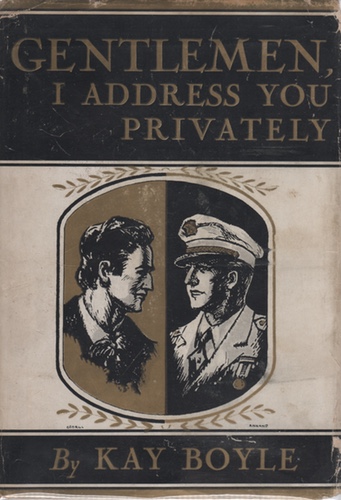
Gentlemen, I Address You Privately by Kay Boyle


New York : Smith and Hass, 1933
Shortly after World War I, an English priest, Munday, defrocked for playing "Poeme de l'Extase" during collection, exiles himself to the Normandy countryside. Here he befriends the Cockney sailor, Ayton, a young man who seems to continually find himself in trouble -- theft, desertion, etc. Before going into hiding, they have the following conversation while Munday sits at his piano. It is clear where the relationship is headed and like others before him, Munday seems unable or unwilling resist young Ayton's charms.


     "We could go away to Mont-St.-Michel," said Ayton softly. "We could go away together."
     "You've gone off too many times," said Munday bitterly. And here was the truth of all his preaching, he thought suddenly in anguish. He was shamed now by the revelation, but now it was too late to falter. "I can't bear to think of you having no choice or discrimination. You've gone off with too many people. You have no pride."
     "But a strong man," said Ayton humbly, and he drew nearer, "could teach me pride, Munday."
     The little man came close to him, and if he moved a finger, thought Munday, his own pride would shatter like crystal. He stood looking down for courage upon the pure flight of keys.
     "We could go off together," said Ayton, "it would be like a pilgrimage together. I would go humbly to the church, very humble, and very grateful for the good that you'll bring to my soul."
     "You've gone off too many times," said Munday again.
     "But never with you," said Ayton.
     "No, never with me," said Munday, but he knew the tower of strength was crumbling in him. It was Ayton who moved, who took up his hand and embraced it; he felt the warm childish lips pressed wildly on his flesh.
     "I want to be saved," Ayton cried out, and he fell on his knees before him. "I can't be damned forever, I'm not an evil man," he said. "I have to be saved, Munday, and it's only you that can save me. I want to be by you always, I want to live my life with you."
     "How many times have you said that before?" said Munday, and his voice was wrung small and strange in his throat.
     "But never to you!" cried Ayton.
     "No, never to me," said Munday in torment. "But now you have said this to me, Ayton, now you have said those words to me."
     He saw the little man's face turned up to him in wonder, and he put out his hands to him, whispering in torment, and followed blindly where he led.
(1st edition (1933), p.105-6)


In 1991, a revised edition of Gentlemen, I Address You Privately was released by Capra Press. Ms. Boyle had completed the revised text shortly before her death. One key change is the transposition of chapters two and three. Apparently, reversed in the original edition, this change corrects an obvious continuity issue within the story. According to a note in the new edition, she had always wanted to revisit this text as she felt that her younger self had 'over-written' it. It's easy to see that she has tightened up the language and removed much of its floweriness (although I rather prefer the floweriness). Part of her discomfort with the original edition may have been due to how open it was, which can particularly be seen in the following passage. In this scene, Munday and Ayton are preparing the ground for planting on Quespelle's farm where they are hiding from the authorities. I've included the quote from the 1933 edition, followed by a conflated quote with strikethroughs showing excisions of the 1933 text and bold red text showing additions from the 1991 text and finally the quote as it appears in the revised 1991 edition.


(1st edition, 1933)
     Munday thrust his spade into the ground, and slowly turned the clots over: deep to the hilt with his foot borne down on the rim, as Ayton had shown him. The earth was rich and full of promise, unused, youthful earth that, for all they knew, had never been sown before. But everything was halted in his body, as though a heavy hand had been laid upon him. A great weight of spring had fallen far and near, and Munday could no longer hasten. He learned to cast the rocks out with his hands, slowly, endlessly striking and turning the soil.
     It was Ayton's strong rhythmic action, he thought, that made his own seem labored. The man moved from tree to tree, dividing his work between two trunks in this fashion, driving deep and pitching out the clumps as though he were devouring the soil. Even the spread and grip of his legs, planted wide and balancing the iron power, seemed braced for subduing an element that ran between. He was no ordinary man preparing the soil for growth, but a wild master of mount, and man, and weather, riding hard the untamed mustang that strained between his thighs.
(1st edition (1933), p.178-9)


(Conflated, 1933 & 1991)
Munday thrust his spade into the ground, and slowly turned the clots over: deep to the hilt it went with his foot borne pressing down on the rim, as Ayton had shown him. The earth was rich and full of promise, unused, youthful earth virgin soil that, for all they knew, had never been sown before. But everything was halted in his body, as though a heavy hand had been laid upon him. A The great weight of spring had seemed to have fallen far and near wide, and Munday could no longer hasten found it difficult to make haste. He learned to cast the rocks out with his hands, slowly Now and then he leaned over to cast the rocks aside, and then returned to endlessly striking and turning the soil.
     It was perhaps Ayton's strong rhythmic action, he thought, that made his own seem labored. The man moved from tree to tree, dividing pursuing his work between two trunks in this fashion, driving deep and pitching out the clumps of earth, he and his spade seeming to as though he were devouring the soil. Even tThe spread and grip of his legs, planted wide and balancing the iron power his weight, seemed were braced for subduing an element that ran between whatever stood in the way. He was no ordinary workman preparing the soil for growth, but a wild master of mount, and man, and weather, riding hard the untamed mustang that strained between his thighs all men and of all seasons of the year.
     It was the supreme authority in Ayton's flesh that humbled Munday, this appalling, almost brutal power of the penetration into the land. Each thrust of the shovel gave increased fervor to his impassioned advance, and in the end he would have the whole universe, clump on clump, uprooted and turned to fallow land. He had no time for speech, no time to turn his head toward Munday. The urgency of every fiber of his being drove each thrust to the subduing of the earth, yet he was still not appeased when each attack was through.
(1st edition (1933), p.178-9 & Revised edition (1991), p.119)


(Revised edition, 1991)
     Munday thrust his spade into the ground, and slowly turned the clots over: deep to the hilt it went with his foot pressing down on the rim, as Ayton had shown him. The earth was rich and full of promise, unused, virgin soil that, for all they knew, had never been sown before. But everything was halted in his body, as though a heavy hand had been laid upon him. The great weight of spring seemed to have fallen far and wide, and Munday found it difficult to make haste. Now and then he leaned over to cast the rocks aside, and then returned to endlessly turning the soil.
     It was perhaps Ayton's strong, rhythmic action that made his own seem labored. The man moved from tree to tree, pursuing his work between two trunks and pitching out the clumps of earth, he and his spade seeming to devour the soil. The spread and grip of his legs, planted wide and balancing his weight, were braced for subduing whatever stood in the way. He was no ordinary workman preparing the soil for growth, but a master of all men and of all seasons of the year.
     It was the supreme authority in Ayton's flesh that humbled Munday, this appalling, almost brutal power of the penetration into the land. Each thrust of the shovel gave increased fervor to his impassioned advance, and in the end he would have the whole universe, clump on clump, uprooted and turned to fallow land. He had no time for speech, no time to turn his head toward Munday. The urgency of every fiber of his being drove each thrust to the subduing of the earth, yet he was still not appeased when each attack was through.
(Revised edition (1991), p.119)


Bibliographies & Ratings: Cory (IV); Garde (Primary, *); Mattachine Review (IV); Young (387)


Friday, March 13, 2015

Lynd Ward's Woodcuts for Myron Brinig's The Flutter of an Eyelid


Myron Brinig, The Flutter of an Eyelid, 1933 : Illustrated by Lynd Ward : Title Page
Myron Brinig, The Flutter of an Eyelid, 1933
Illustrated by Lynd Ward
Title Page
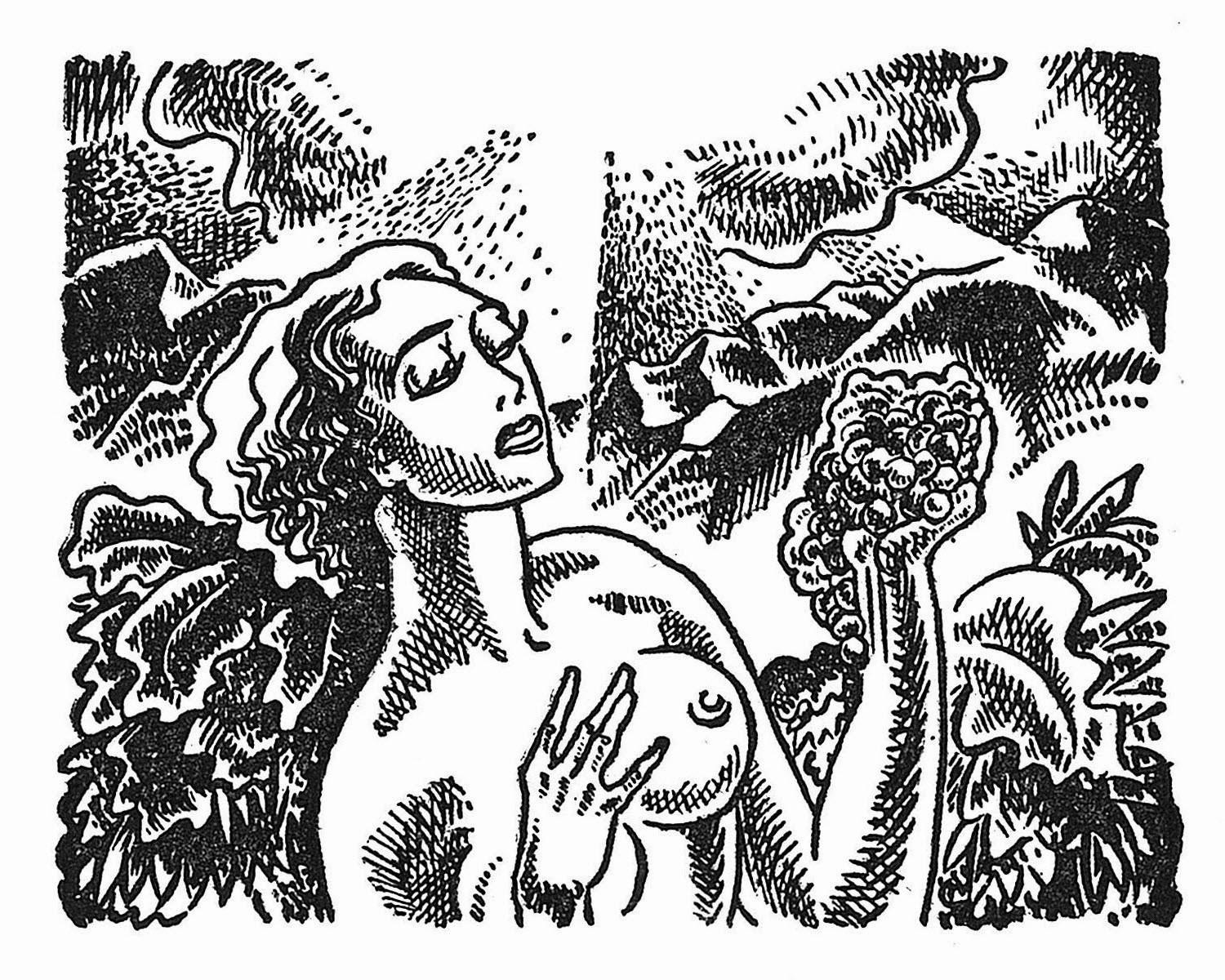
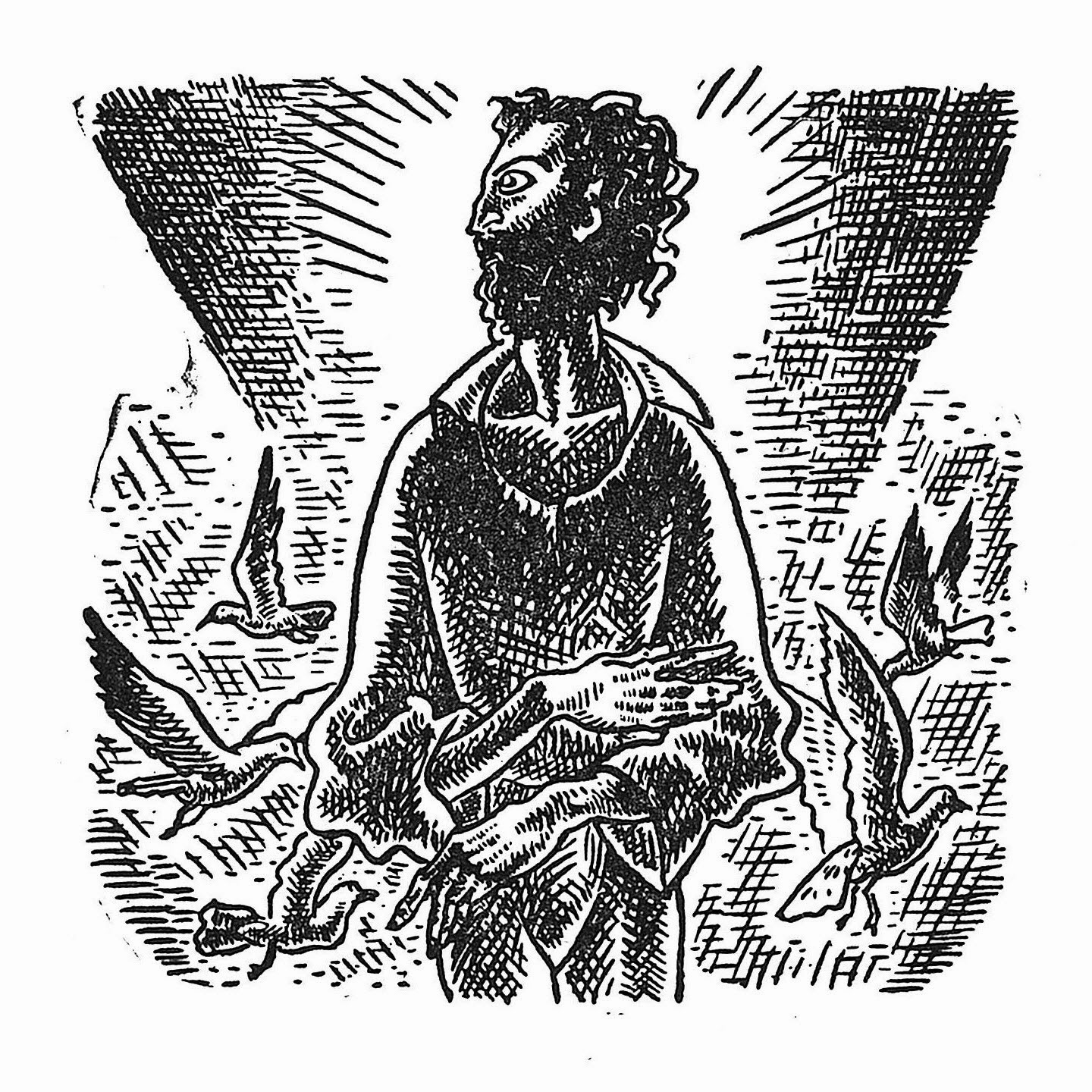
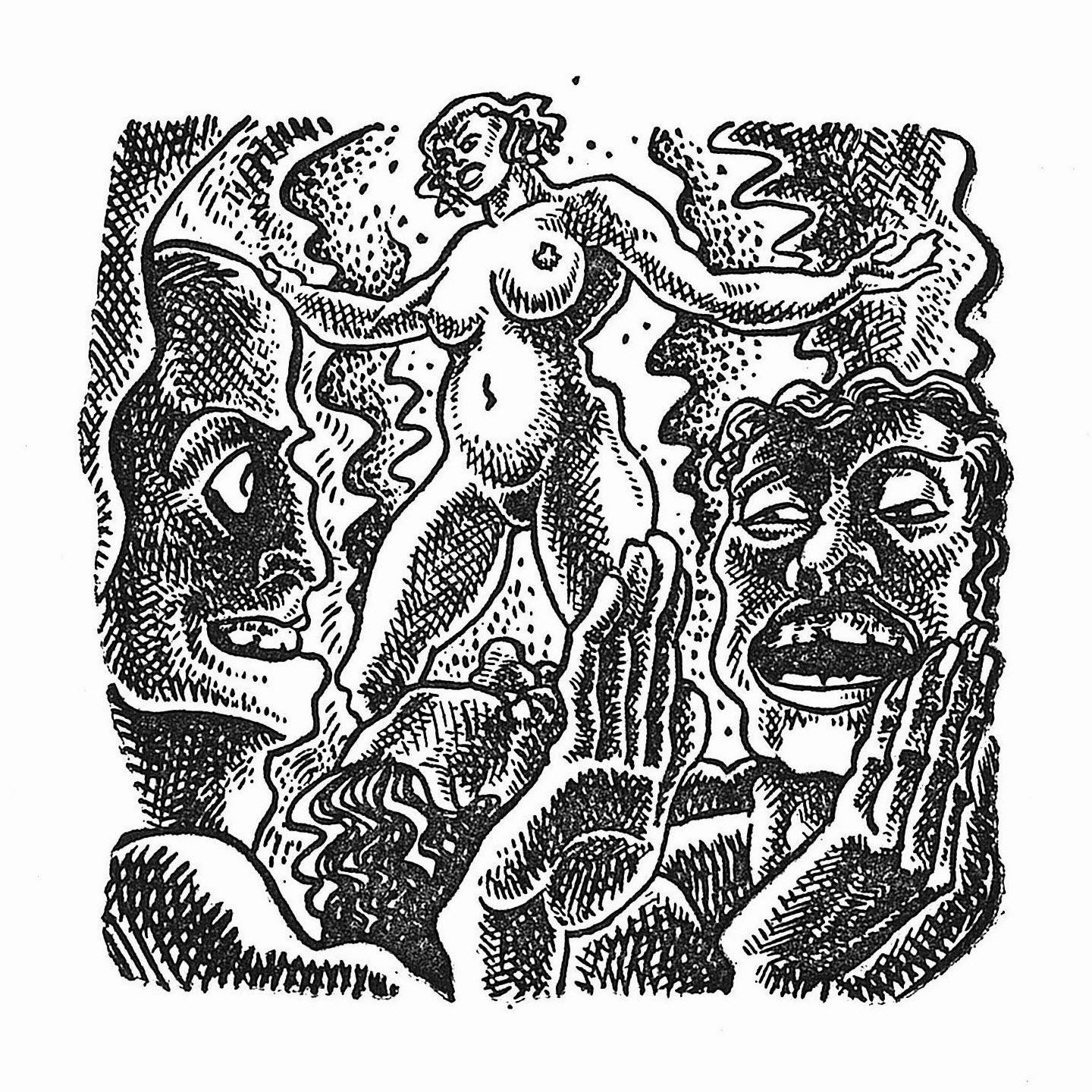
One of the lovely things about Myron Brinig's The Flutter of an Eyelid is the illustrations by Lynd Ward. A simple 1-inch square woodcut at the beginning of each chapter illustrates the key events of that chapter in a surprisingly complete way. Ward is particularly skilled at this since he 'wrote' six novels without words in the 1920s and 1930s (God's Man, Madman's Drum, Wild Pilgrimage, Prelude to a Million Years, Song Without Words, and Vertigo), each work telling a story through a series of woodcuts. The form requires the 'reader' to sit with the images, sometimes returning to earlier ones, each time picking up some subtle nuance not previously seen.

The woodcuts for The Flutter of an Eyelid perfectly fit the story which has both classical and modern themes. They illustrate this particular story but at the same time feel completely timeless.

Brinig, The Flutter of an Eyelid, 1933 : Illustrated by Lynd Ward : I: Approach by Sea
Myron Brinig, The Flutter of an Eyelid, 1933
Illustrated by Lynd Ward
I: Approach by Sea
Myron Brinig, The Flutter of an Eyelid, 1933 : Illustrated by Lynd Ward : II: A Sunny Day in California
Myron Brinig, The Flutter of an Eyelid, 1933
Illustrated by Lynd Ward
II: A Sunny Day in California
Myron Brinig, The Flutter of an Eyelid, 1933 : Illustrated by Lynd Ward : III: The Black Tub
Myron Brinig, The Flutter of an Eyelid, 1933
Illustrated by Lynd Ward
III: The Black Tub
Myron Brinig, The Flutter of an Eyelid, 1933 : Illustrated by Lynd Ward : IV: Characters of the Novel
Myron Brinig, The Flutter of an Eyelid, 1933
Illustrated by Lynd Ward
IV: Characters of the Novel
Myron Brinig, The Flutter of an Eyelid, 1933 : Illustrated by Lynd Ward : V: Nudes on the Beach
Myron Brinig, The Flutter of an Eyelid, 1933
Illustrated by Lynd Ward
V: Nudes on the Beach
Myron Brinig, The Flutter of an Eyelid, 1933 : Illustrated by Lynd Ward : VI: The Boat of Yang Kuo-chung
Myron Brinig, The Flutter of an Eyelid, 1933
Illustrated by Lynd Ward
VI: The Boat of Yang Kuo-chung
Myron Brinig, The Flutter of an Eyelid, 1933 : Illustrated by Lynd Ward : VII: L'Après Midi d'un Faune
Myron Brinig, The Flutter of an Eyelid, 1933
Illustrated by Lynd Ward
VII: L'Après Midi d'un Faune
Myron Brinig, The Flutter of an Eyelid, 1933 : Illustrated by Lynd Ward : VIII: A Woman in Christ's Shadow
Myron Brinig, The Flutter of an Eyelid, 1933
Illustrated by Lynd Ward
VIII: A Woman in Christ's Shadow
Myron Brinig, The Flutter of an Eyelid, 1933 : Illustrated by Lynd Ward : IX: Music at Dark
Myron Brinig, The Flutter of an Eyelid, 1933
Illustrated by Lynd Ward
IX: Music at Dark
Myron Brinig, The Flutter of an Eyelid, 1933 : Illustrated by Lynd Ward : X: Passion Upon a Cold and Thoughtful Stone
Myron Brinig, The Flutter of an Eyelid, 1933
Illustrated by Lynd Ward
X: Passion Upon a Cold and Thoughtful Stone
Myron Brinig, The Flutter of an Eyelid, 1933 : Illustrated by Lynd Ward : XI: The Road is Long
Myron Brinig, The Flutter of an Eyelid, 1933
Illustrated by Lynd Ward
XI: The Road is Long
Myron Brinig, The Flutter of an Eyelid, 1933 : Illustrated by Lynd Ward : XII: The Tempest
Myron Brinig, The Flutter of an Eyelid, 1933
Illustrated by Lynd Ward
XII: The Tempest
Myron Brinig, The Flutter of an Eyelid, 1933 : Illustrated by Lynd Ward : XIII: Life and Times of Lad Greengable: The Wanderer
Myron Brinig, The Flutter of an Eyelid, 1933
Illustrated by Lynd Ward
XIII: Life and Times of Lad Greengable: The Wanderer
Myron Brinig, The Flutter of an Eyelid, 1933 : Illustrated by Lynd Ward : XIV: Worshippers of the Moon
Myron Brinig, The Flutter of an Eyelid, 1933
Illustrated by Lynd Ward
XIV: Worshippers of the Moon
Myron Brinig, The Flutter of an Eyelid, 1933 : Illustrated by Lynd Ward : XV: Time, Gentlemen, Time!
Myron Brinig, The Flutter of an Eyelid, 1933
Illustrated by Lynd Ward
XV: Time, Gentlemen, Time!
Myron Brinig, The Flutter of an Eyelid, 1933 : Illustrated by Lynd Ward : XVI: Make Way for the Lord
Myron Brinig, The Flutter of an Eyelid, 1933
Illustrated by Lynd Ward
XVI: Make Way for the Lord
Myron Brinig, The Flutter of an Eyelid, 1933 : Illustrated by Lynd Ward : XVII: Opium
Myron Brinig, The Flutter of an Eyelid, 1933
Illustrated by Lynd Ward
XVII: Opium
Myron Brinig, The Flutter of an Eyelid, 1933 : Illustrated by Lynd Ward : XVIII: Tragedy at Sea
Myron Brinig, The Flutter of an Eyelid, 1933
Illustrated by Lynd Ward
XVIII: Tragedy at Sea
Myron Brinig, The Flutter of an Eyelid, 1933 : Illustrated by Lynd Ward : XIX: Life and Times of Lad Greengable: À Rebours
Myron Brinig, The Flutter of an Eyelid, 1933
Illustrated by Lynd Ward
XIX: Life and Times of Lad Greengable: À Rebours
Myron Brinig, The Flutter of an Eyelid, 1933 : Illustrated by Lynd Ward : XX: Preludes
Myron Brinig, The Flutter of an Eyelid, 1933
Illustrated by Lynd Ward
XX: Preludes
Myron Brinig, The Flutter of an Eyelid, 1933 : Illustrated by Lynd Ward : XXI: Dorosel
Myron Brinig, The Flutter of an Eyelid, 1933
Illustrated by Lynd Ward
XXI: Dorosel
Myron Brinig, The Flutter of an Eyelid, 1933 : Illustrated by Lynd Ward : XXII: Death of a Poet
Myron Brinig, The Flutter of an Eyelid, 1933
Illustrated by Lynd Ward
XXII: Death of a Poet
Myron Brinig, The Flutter of an Eyelid, 1933 : Illustrated by Lynd Ward : XXIII: Tears in the Evening
Myron Brinig, The Flutter of an Eyelid, 1933
Illustrated by Lynd Ward
XXIII: Tears in the Evening
Myron Brinig, The Flutter of an Eyelid, 1933 : Illustrated by Lynd Ward : XXIV: Jainticanto
Myron Brinig, The Flutter of an Eyelid, 1933
Illustrated by Lynd Ward
XXIV: Jainticanto
Myron Brinig, The Flutter of an Eyelid, 1933 : Illustrated by Lynd Ward : XXV: Concerto
Myron Brinig, The Flutter of an Eyelid, 1933
Illustrated by Lynd Ward
XXV: Concerto
Myron Brinig, The Flutter of an Eyelid, 1933 : Illustrated by Lynd Ward : XXVI: The Lavengros
Myron Brinig, The Flutter of an Eyelid, 1933
Illustrated by Lynd Ward
XXVI: The Lavengros
Myron Brinig, The Flutter of an Eyelid, 1933 : Illustrated by Lynd Ward : XXVII: Five Points of a Star
Myron Brinig, The Flutter of an Eyelid, 1933
Illustrated by Lynd Ward
XXVII: Five Points of a Star
Myron Brinig, The Flutter of an Eyelid, 1933 : Illustrated by Lynd Ward : XXVIII: A Pitiful Little Man
Myron Brinig, The Flutter of an Eyelid, 1933
Illustrated by Lynd Ward
XXVIII: A Pitiful Little Man
Myron Brinig, The Flutter of an Eyelid, 1933 : Illustrated by Lynd Ward : XXIX: Prisoners
Myron Brinig, The Flutter of an Eyelid, 1933
Illustrated by Lynd Ward
XXIX: Prisoners
Myron Brinig, The Flutter of an Eyelid, 1933 : Illustrated by Lynd Ward : XXX: Violet Colored Mazes of Defeat
Myron Brinig, The Flutter of an Eyelid, 1933
Illustrated by Lynd Ward
XXX: Violet Colored Mazes of Defeat
Myron Brinig, The Flutter of an Eyelid, 1933 : Illustrated by Lynd Ward : XXXI: The Day Was a Great Golden Cube
Myron Brinig, The Flutter of an Eyelid, 1933
Illustrated by Lynd Ward
XXXI: The Day Was a Great Golden Cube
Myron Brinig, The Flutter of an Eyelid, 1933 : Illustrated by Lynd Ward : XXXII: Sinners in the Temple
Myron Brinig, The Flutter of an Eyelid, 1933
Illustrated by Lynd Ward
XXXII: Sinners in the Temple
Myron Brinig, The Flutter of an Eyelid, 1933 : Illustrated by Lynd Ward : XXXIII: End of the Novel
Myron Brinig, The Flutter of an Eyelid, 1933
Illustrated by Lynd Ward
XXXIII: End of the Novel
Myron Brinig, The Flutter of an Eyelid, 1933 : Illustrated by Lynd Ward : XXXIV: New England Interior
Myron Brinig, The Flutter of an Eyelid, 1933
Illustrated by Lynd Ward
XXXIV: New England Interior
Myron Brinig, The Flutter of an Eyelid, 1933 : Illustrated by Lynd Ward : XXXV: The Trial
Myron Brinig, The Flutter of an Eyelid, 1933
Illustrated by Lynd Ward
XXXV: The Trial
Myron Brinig, The Flutter of an Eyelid, 1933 : Illustrated by Lynd Ward : XXXVI: Departure to the Sea
Myron Brinig, The Flutter of an Eyelid, 1933
Illustrated by Lynd Ward
XXXVI: Departure to the Sea
Myron Brinig, The Flutter of an Eyelid, 1933 : Illustrated by Lynd Ward : XXXVII: Finis
Myron Brinig, The Flutter of an Eyelid, 1933
Illustrated by Lynd Ward
XXXVII: Finis


The Flutter of an Eyelid by Myron Brinig

The flutter of an eyelid. Digital ID: 495331. New York Public Library
New York : Farrar & Rinehart, 1933
Linked image: New York Public Library, Collection of Book Jackets
Myron Brinig's The Flutter of an Eyelid is the story of writer, Caslon Roanoke who arrives in Los Angeles to work on his latest novel. His neighbors are an interesting bunch and he constructs his novel around them. Over time, it becomes less and less clear to the reader whether we are reading what is actually happening or if we are reading Roanoke's  novel.

A gay reading of the text centers on Mrs. Forgate, reputed murderer of several husbands, her young boyfriend Antonio and Hubert Daché, a poet from Texas. Antonio and Hubert's budding relationship is problematic for Mrs. Forgate and dangerous for them.

In Earl Ganz' novel, The Taos Truth Game, Myron Brinig appears as the main character and describes the story behind the publication of The Flutter of an Eyelid. The conversation is between Hal (poet, Witter Bynner) and Myron Brinig (p.40-41).
The Taos Truth Game by Earl Ganz; Albuquerque: University of New Mexico Press, 2006
Albuquerque: University of New
Mexico Press, 2006
     "Myron, before I forget, " said the poet, "I want you to sign something for me." And he led Myron to a table on which lay a copy of The Flutter of an Eyelid.
     "Where'd you get this?" asked Myron, picking the book up.
     "I had Villagra save it for me."
     "You read it?" Myron asked in spite of himself. The question always sounded like begging.
     " Yes and I loved it," said Hal. "It's South Wind set in Malibu. And some of it's about people like us."
     "It's all about people like us," said Myron.
     "So what happened?"
     "A woman in LA thought she saw herself in it and brought suit."
     "Farrar & Rinehart wouldn't go to bat for you?"
     "No."
     "Was it her?"
     "The person I took the character from was a man. It was Farrar & Rinehart who asked me to change the gender."
     "So they knew who the character was and still wouldn't defend you?"
     "That's right. They'd rather take the loss than admit they had published a novel about homosexuals.
Bibliographies & Ratings: While Brinig's This Man is My Brother (1932) is listed in all four bibliographies, The Flutter of an Eyelid, also with obvious gay content, is absent. Perhaps the withdrawal of the title by the publisher is to blame for this oversight.