Showing posts with label James Levin. Show all posts

Saturday, February 6, 2021

Bibliographies of Gay Literature II

In 2014, I posted about a handful of early 20th century bibliographies of gay literature, covering novels, short stories, plays and in some cases biography and biographical fiction. Those publications not only tried to provide a list of titles but also described them through various ratings systems to declare the extent of the gay content and/or the nature of the content. A number of other bibliographies that are more descriptive in nature, and focus exclusively on the novel have also been published and are presented here. A single work focused entirely on plays has also been included as it can be thought of as the third part in a mammoth undertaking covering British Commonwealth and American novels and plays by Drewey Wayne Gunn.  This batch of bibliographies focus more on thumbnail sketches, and in some cases more lengthy analysis, of the storyline as opposed to boiling things down to a single rating. Using resources from both groups of bibliographies together can provide a more complete picture of an individual novel or play.


Playing the Game : The Homosexual Novel in America by Roger Austen Indianapolis : Bobbs-Merrill, 1977
Indianapolis : Bobbs-Merrill, 1977
Playing the Game : The Homosexual Novel in America

Austen, Roger
Indianapolis : Bobbs-Merrill, 1977

Austen provides information about the publications he covers in a prose style as opposed to a list. Structured into chapters covering chronological segments of history, novel storylines are discussed and played off of one another. 

•  The Dim Past (1870-1929)
•  The Thirties
•  The Forties
•  The Fifties
•  Since 1960

The Selected Bibliography (1870-1965) offered at the end of the text provides a quick list of the titles covered in the preceding chapters. 


The Gay Novel in America by James Levin New York: Garland Publishing, 1991
New York : Garland, 1991
The Gay Novel in America

Levin, James
New York: Garland Publishing, 1991

Structurally, Levin's The Gay Novel in America owes much to Austen's 1977 work. Also structured into prose chapters covering segments of literary history, but more fully fleshing out the earliest literature, Levin also pushes forward to the 1980s.

•  Locked in Victoria's Closet
•  Butterflies, Pansies, Twilight Men, and Strange Brothers
    —The Novel Between the Wars
•  Postwar Permissiveness: 1946-1950
•  Homosexuality in the Freudian Fifties
•  The Sixties: Time of Transition
•  Politics, Power, and Pride
•  The Enigmatic Eighties

The Notes section at the end of each chapter also serves as a quick list of titles discussed within the chapter.


Lost Gay Novels : A Reference Guide to Fifty Works from the First Half of the Twentieth Century by Anthony Slide New York : Harrington Park Press, 2003
New York : Harrington Park Press, 2003
Lost Gay Novels : A Reference Guide to Fifty Works from the First Half of the Twentieth Century
Slide, Anthony
New York : Harrington Park Press, 2003

Slide offers a narrower list of titles, limiting the bibliography to fifty, but provides a lengthy entry of 3-5 pages for each title. Major storylines and themes are discussed as well as providing biographical information on the authors. Titles are listed in alphabetical order by author but an appendix also provides the titles and authors in chronological order. Some of the commentary on the relative literary quality is a bit harsh towards the works discussed, but the value of the remaining content is not diminished. One can certainly argue how truly lost some of these titles are but highlighting those that may be known to some of us is of benefit to all who are interested in gay novels from the early 20th century.


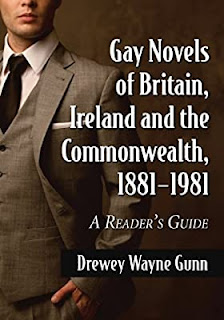
Gay Novels of Britain, Ireland and the Commonwealth, 1881-1981 : A Reader's Guide by Drewey Wayne Gunn Jefferson, NC : McFarland, 2014
Jefferson, NC : McFarland, 2014
Gay Novels of Britain, Ireland and the Commonwealth, 1881-1981 : A Reader's Guide
Gunn, Drewey Wayne
Jefferson, NC : McFarland, 2014

Gunn's British Commonwealth bibliography, covering one hundred years, consists of numbered entries arranged in chronological order from 1881 to 1981, marking the end of the pre-AIDS era.  Many entries cover multiple titles and are grouped in one of two ways ; multiple titles published within a short time-frame with a common element or theme or multiple titles by the same author covering a longer time frame. Short biographical entries are provided for many authors. A postscript provides a general sketch of politics and publishing after 1981.


Gay American Novels, 1870-1970 : A Reader's Guide by Drewey Wayne Gunn Jefferson, NC : McFarland, 2016
Jefferson, NC : McFarland, 2016
Gay American Novels, 1870-1970 : A Reader's Guide
Gunn, Drewey Wayne
Jefferson, NC : McFarland, 2016

Gunn's American bibliography, covering one hundred years, consists of numbered entries arranged in chronological order from 1870 to 1970, marking the end of the pre-Stonewall era.  Many entries cover multiple titles and are grouped in one of two ways ; multiple titles published within a short time-frame with a common element or theme or multiple titles by the same author covering a longer time frame. Short biographical entries are provided for many authors. A postscript provides a sketch of major works from 1971-1981, ending where his British Commonwealth bibliography does, at the end of the pre-AIDS era.


For the Gay Stage : A Guide to 456 Plays, Aristophanes to Peter Gill by Drewey Wayne Gunn Jefferson, NC : McFarland, 2017
Jefferson, NC : McFarland, 2017
For the Gay Stage : A Guide to 456 Plays, Aristophanes to Peter Gill
Gunn, Drewey Wayne
Jefferson, NC : McFarland, 2017

Gunn's bibliography of plays covers a the huge time period from the 5th century BCE through 2014. Consistent with his earlier bibliographies for British Commonwealth and American novels, numbered entries are arranged in chronological order and provide the play's storyline and information about production history.  Play entries have been grouped into the following chapters opening with a brief list of major gay historical or cultural events from the period. 

•  Pre-Modern, 5th c. BCE-18th c. CE
•  Early Modern, 1881-1943
•  Post-World War II, 1945-1969
•  Post-Stonewall, 1970-1981
•  AIDS, 1982-1989
•  Early Nineties, 1990-1994
•  Pre-Millennium, 1995-2000
•  Early Contemporary, 2001-2007
•  Recent Contemporary, 2008-2014


Sunday, January 3, 2016

Goldie by Kennilworth Bruce

Goldie by Kennilworth Bruce; New York : William Goodwin, 1933
New York : William Goodwin, 1933
Of the gay novels of the 1930s, Goldie is the most elusive. Held by less than a handful of libraries (in special collections departments), one assumes that there are no more than an equal number being held by independent collectors. Some kind soul posted the image I include here on LibraryThing.

Synopses of this rare novel appear in three publications. Roger Austen's is the first and most complete in his Playing the Game: The Homosexual Novel in America (1977). James Levin's The Gay Novel in America (1991) and John Laughery's The Other Side of Silence: Men's Lives and Gay Identities: A Twentieth-Century History (1998) both rely on Austen (as I will).

A young man from the midwest, Paul Kameron, is an ace pilot with the Royal Flying Corps during World War I. Bailing out over Germany, he is 'brought out' while being held in a POW camp. After the war, he returns to New York with his lover, a furrier he met in Europe. Paul grows more comfortable with having entered 'Limbo' (his term for 'the gay life') when he discovers there are "more than four million others in the United States who dwelt in that twilight realm of sex."

Paul transforms into Goldie when he begins dying his hair. After his lover catches him with the shop janitor, he breaks it off and Goldie is left to hustle on Broadway. He later has an affair with a gangster and starts working in a gay restaurant in the Village.

Goldie's friend, Jack Shaw, has the idea to form a gay liberation club. Its first meeting takes place in the restaurant and draws six people, including Goldie. In drafting their resolution, they aim to abolish the laws in the State of New York that make 'inversion' a crime. They cite both France and Italy having both eliminated similar laws over 100 years ago. Thus, The Twilight League was born. And just as quickly it met its demise due to its members each having plans to exploit the League in different ways, up to and including running a connections service where "wolves could obtain fairies."

Laughery, in The Other Side of Silence, ends his synopsis of Goldie by asking the question "... in 1933 who knew any homosexuals who thought they had civil rights to agitate for?" George Chauncey's Gay New York: Gender, Urban Culture, and the Making of the Gay Male World 1890-1940 (1994) offers a place to start answering this question.

FROM TOP TO BOTTOM: Magnus Hirschfeld, Henry Gerber
FROM TOP TO BOTTOM: Magnus
Hirschfeld, Henry Gerber
It is accepted that the mass mobilization of American men during WWII and their exposure to more progressive attitudes about sexuality in Europe led gay men after the war to see new possibilities for their own lives, especially as they settled in New York and San Fransisco. The evidence also suggests that service members during WWI, albeit fewer of them, were also exposed to a cultural and political climate for homosexuals in both Paris and Berlin which far surpassed what they could have imagined in small-town America or even New York.

Magnus Hirschfeld founded The Wissenschaftlich-humanitäres Komitee (Scientific-Humanitarian Committee) in May 1897 to campaign for legal recognition of gay lesbian and transgender men and women and against their persecution (specifically Paragraph 175). It was the earliest gay rights group, but certainly not the only one in early 20th century Berlin. It continued its activities through 1933, when the Nazis destroyed The Institut for Sexualwissenschaft  (Institute for Sexual Sciences) which housed it's offices.

From 1920 to 1923, Henry Gerber had served with the Army of Occupation in Germany after WWI and had seen firsthand the openness of Berlin during this time and was upset about the way homosexuals were treated in the United States. In December 1924, now living in Chicago, Gerber founded The Society for Human Rights by filing a charter with the State of Illinois. Gerber chose to use the same name as was used by the german group he most closely identified with, Bund für Menschenrecht (The Society for Human Rights).

A police raid and subsequent arrests brought The Society for Human Rights abruptly to an end in the summer of 1925. Gerber's Society had concentrated  its efforts on the State of Illinois where they focused on reforming laws that criminalized homosexual acts. This sounds suspiciously similar to the goals of The Twilight League in the State of New York in Kenilworth Bruce's Goldie. After three costly trials for deviancy (all eventually dismissed), and the loss of his job with the post office, Gerber relocated to New York. One wonders if Kennilworth Bruce didn't borrow from Gerber's life when writing Goldie.

For more about Goldie and hustler culture, see George Chauncey's Gay New York: Gender, Urban Culture, and the Making of the Gay Male World 1890-1940 (1994) and Mack Friedman's Strapped for Cash: A History of America's Hustler Culture (2003). For an excellent history of the gay rights movement in Berlin see, Robert Beachy's Gay Berlin: Birthplace of a Modern Identity (2014). For more about Henry Gerber and The Society for Human Rights, see Jonathan Ned Katz' Gay American History: Lesbians & Gay Men in the U.S.A., Revised Edition (1992).


Bibliographies & Ratings: Mattachine Review (P); Young (490,*) Note that the Mattachine Review rating of P is not defined in the legend but may be a typo for O, which means it was not examined but is believed to have pertinent content. Garde specifically excludes works that could not be examined.