 |
| Murder (1942) Jared French (American, 1905-1988) Egg tempera on plaster coated panel 43.18 x 36.83 cm The Pennsylvania Academy of the Fine Arts |
Wednesday, April 21, 2021
Murder by Jared French

Tuesday, April 6, 2021
The End of My Life by Vance Bourjaily
 |
| New York : Scribner's, 1947 |
Freak is the most 'normal guy' of the bunch and has joined the ambulance crew to do his part after failing to pass the medical exam for entry into the military. Benny, a Jewish communist understands the importance of the war and what it means for the future of the world, but particularly the future of the Jewish people and himself. Rod is a night club musician who doesn't stay in one place for long and doesn't seem to make lasting connections. Finally, Skinner Galt is the main character through whose eyes we see the action of the novel and feel the struggle of the characters.
Homosexuality is frankly acknowledged by all of the characters and it is understood that there are plenty of gay men in the military. Although it happens away from the action of the novel, Rod's relationship with one of the gay men in the ambulance outfit is offered in all its complexity. Rod isn't comfortable with what it means for him, particularly what it means for his mental health but at the same time he describes his feelings as love. So while the characters follow the gayness as illness paradigm of the time, they are also allowing for the relationship to be based on an emotional connection, not simply a physical or sexual one.
At its core, this novel is an exploration of what it means to be human. We like to think that we are all acting as individuals so what we do only affects ourselves. We don't like to acknowledge that our collective actions reflect on humanity as a whole. In Skinner's case, he doesn't get to separate himself from the consequences of war just because he drove an ambulance instead of firing a gun. As Benny points out toward the end of the novel, no human being is an exception to humanity.
Bibliographies & Ratings: Cory (IV); Garde (P, 117***); Mattachine Review (IV); Young (3259*)
Bibliographies & Ratings II: Gunn (American 37b); Levin (69); Slide (7)
Thursday, March 25, 2021
Rough Trade by Arthur Lett-Haines
 |
| Rough Trade (1935) Arthur Lett-Haines (English, 1894-1978) Watercolor and crayon on paper 26.7 x 21.6 cm. |
Tuesday, March 9, 2021
Sojourn Among Shadows by Murrell Edmunds
 |
| Caldwell, ID : Caxton, 1936 |
The story's young protagonist grows up the son of a preacher who is less than godly in his behavior. His mother dies and he is rescued from his abusive father by his uncle, Tom. Uncle Tom feels it important to get him away from his father but doesn't see himself as a person fit for him to be with. The boy's father often argued with his wife regarding Uncle Tom's 'degeneracy' and she would point out that it was his god that had created Uncle Tom. Hoping to protect the young man from his 'vagabond life', Uncle Tom places him with a family only to later learn that he has seen the truth of the world even in isolation.
The novel is complicated by the author's decision not to provide names for most of the characters. Some characters are eventually named, but names are offered as an aside after the bulk of the action involving them has passed. The only character that from the start is given a name is Uncle Tom, and this is maybe not completely surprising. Edmunds tackled controversial issues in his life and in his writings, having been a strong voice against Jim Crow laws. Written in the form of a fable, this novel, while not a true defense of homosexuality, does argue all humans are born as their creator intended. Using the name Uncle Tom for one of his characters and also making that character gay may be a way of showing a connection between the challenges faced by both blacks and gays.
Bibliographies & Ratings: Young (1135)
Thursday, February 18, 2021

Saturday, February 6, 2021
Bibliographies of Gay Literature II
In 2014, I posted about a handful of early 20th century bibliographies of gay literature, covering novels, short stories, plays and in some cases biography and biographical fiction. Those publications not only tried to provide a list of titles but also described them through various ratings systems to declare the extent of the gay content and/or the nature of the content. A number of other bibliographies that are more descriptive in nature, and focus exclusively on the novel have also been published and are presented here. A single work focused entirely on plays has also been included as it can be thought of as the third part in a mammoth undertaking covering British Commonwealth and American novels and plays by Drewey Wayne Gunn. This batch of bibliographies focus more on thumbnail sketches, and in some cases more lengthy analysis, of the storyline as opposed to boiling things down to a single rating. Using resources from both groups of bibliographies together can provide a more complete picture of an individual novel or play.
 |
| Indianapolis : Bobbs-Merrill, 1977 |
Austen, Roger
Indianapolis : Bobbs-Merrill, 1977
Austen provides information about the publications he covers in a prose style as opposed to a list. Structured into chapters covering chronological segments of history, novel storylines are discussed and played off of one another.
• The Dim Past (1870-1929)
• The Thirties
• The Forties
• The Fifties
• Since 1960
The Selected Bibliography (1870-1965) offered at the end of the text provides a quick list of the titles covered in the preceding chapters.
 |
| New York : Garland, 1991 |
Levin, James
New York: Garland Publishing, 1991
Structurally, Levin's The Gay Novel in America owes much to Austen's 1977 work. Also structured into prose chapters covering segments of literary history, but more fully fleshing out the earliest literature, Levin also pushes forward to the 1980s.
• Locked in Victoria's Closet
• Butterflies, Pansies, Twilight Men, and Strange Brothers
—The Novel Between the Wars
• Postwar Permissiveness: 1946-1950
• Homosexuality in the Freudian Fifties
• The Sixties: Time of Transition
• Politics, Power, and Pride
• The Enigmatic Eighties
The Notes section at the end of each chapter also serves as a quick list of titles discussed within the chapter.
 |
| New York : Harrington Park Press, 2003 |
Slide, Anthony
New York : Harrington Park Press, 2003
Slide offers a narrower list of titles, limiting the bibliography to fifty, but provides a lengthy entry of 3-5 pages for each title. Major storylines and themes are discussed as well as providing biographical information on the authors. Titles are listed in alphabetical order by author but an appendix also provides the titles and authors in chronological order. Some of the commentary on the relative literary quality is a bit harsh towards the works discussed, but the value of the remaining content is not diminished. One can certainly argue how truly lost some of these titles are but highlighting those that may be known to some of us is of benefit to all who are interested in gay novels from the early 20th century.
 |
| Jefferson, NC : McFarland, 2014 |
Gunn, Drewey Wayne
Jefferson, NC : McFarland, 2014
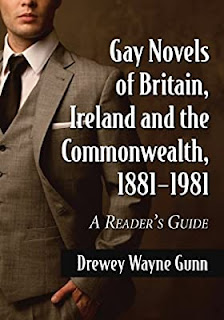
Gunn's British Commonwealth bibliography, covering one hundred years, consists of numbered entries arranged in chronological order from 1881 to 1981, marking the end of the pre-AIDS era. Many entries cover multiple titles and are grouped in one of two ways ; multiple titles published within a short time-frame with a common element or theme or multiple titles by the same author covering a longer time frame. Short biographical entries are provided for many authors. A postscript provides a general sketch of politics and publishing after 1981.
 |
| Jefferson, NC : McFarland, 2016 |
Gunn, Drewey Wayne
Jefferson, NC : McFarland, 2016Gunn's American bibliography, covering one hundred years, consists of numbered entries arranged in chronological order from 1870 to 1970, marking the end of the pre-Stonewall era. Many entries cover multiple titles and are grouped in one of two ways ; multiple titles published within a short time-frame with a common element or theme or multiple titles by the same author covering a longer time frame. Short biographical entries are provided for many authors. A postscript provides a sketch of major works from 1971-1981, ending where his British Commonwealth bibliography does, at the end of the pre-AIDS era.
 |
| Jefferson, NC : McFarland, 2017 |
For the Gay Stage : A Guide to 456 Plays, Aristophanes to Peter Gill
Gunn, Drewey Wayne
Jefferson, NC : McFarland, 2017
Gunn's bibliography of plays covers a the huge time period from the 5th century BCE through 2014. Consistent with his earlier bibliographies for British Commonwealth and American novels, numbered entries are arranged in chronological order and provide the play's storyline and information about production history. Play entries have been grouped into the following chapters opening with a brief list of major gay historical or cultural events from the period.
• Pre-Modern, 5th c. BCE-18th c. CE
• Early Modern, 1881-1943
• Post-World War II, 1945-1969
• Post-Stonewall, 1970-1981
• AIDS, 1982-1989
• Early Nineties, 1990-1994
• Pre-Millennium, 1995-2000
• Early Contemporary, 2001-2007
• Recent Contemporary, 2008-2014
Thursday, January 28, 2021
The East Window by Edward Brian Seago
 |
| The East Window (1944) Edward Brian Seago (English, 1910-1974) Oil on hardboard 48.8 x 37 cm Norfolk Museums Service |
Subscribe to:
Posts (Atom)