 |
| Ynglingen och döden = Young Man with Death (1908) Gösta Adrian-Nilsson (GAN) (Swedish, 1884-1965) Gouache and watercolor on cardboard 56.5 x 38 cm (22.2 x 15 in.) |
Wednesday, January 26, 2022
Ynglingen och döden (Young Man with Death) by Gösta Adrian-Nilsson (GAN)

Tuesday, January 11, 2022
Coup de Grâce by Marguerite Yourcenar
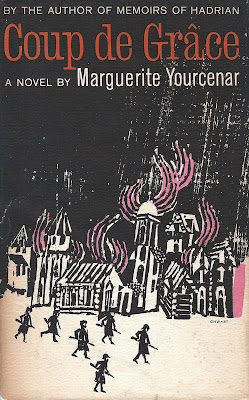 |
| New York : Farrar, Straus & Cudahy, 1957 |
Not released in English until 1957—after the success of Memoirs of Hadrian—the original French edition of Coup de Grâce had been published in 1939. The novel opens with our main character Erick von Lhomond, recently injured during the Spanish Civil War, returning to Germany by way of Italy. Among the other mercenaries, he begins to tell his story of war, going all the way back to the Bolshevik Revolution.
Although he had trained to join the German military during World War I, he was still too young to fight before the war ended. His father, having died at Verdun, left the family in debt. Between his need to fight and his family's need for money, he decides to join German forces fighting the Bolsheviks in Kurland (Courland) in what is modern-day Latvia. Erick had spent the happiest times of his youth there with relatives in the home of the Count of Reval, which now served as a barracks for the fighters. Erick's childhood friend Conrad fights alongside him and Conrad's sister, Sophie helps to care for all of the soldiers.
Only a few years have passed since the happiness of his youth and Erick easily reconnects with Conrad. What he doesn't expect is the more mature attentions of Sophie. He continuously deflects her attentions, which become quite overt. He seems unwilling to be honest about the reasons for his dismissal of her advances—his feelings for Conrad. His youth means that he doesn't really know what he feels. He refers to his 'indispensable vice' and how it 'is much less the love for boys, than for solitude.' In the end, his time in that house, both as a child, and as a soldier was never about games or war, it was always about Conrad.
Told only from Erick's perspective, we hear about his inner feelings and only the perceived feelings of those around him. His tendency toward solitude, largely brought on by the uncertainty of a future in war-worn Europe, kept him from sharing his feelings with those around him. It's a heartbreaking story of lost youth and lost love.
Bibliographies & Ratings: Cory (III); Garde (OTP, c/d*); Mattachine Review (III); Young (4273)
Tuesday, December 21, 2021
Aubrey Beardsley by Jacques-Emile Blanche
 |
| Aubrey Beardsley (1895) Jacques-Emile Blanche (French, 1861-1942) Oil on canvas 36.5 x 29 in. (92.6 x 73.7 cm.) © National Portrait Gallery, London |
Wednesday, December 8, 2021
The Confessions of Aubrey Beardsley by Donald S. Olson
 |
| London : Bantam Press, 1993 |
The Confessions of Aubrey Beardsley opens in the final years of Aubrey Beardsley's life. He has committed himself to converting to Catholicism prior to his impending death at the age of 25 from tuberculosis. As a matter of survival, becoming Catholic or moving to the continent were the common choices among gay men in England after the Wilde trial. Beardsley provides his full confession to Père Coubé, a French priest, through a series of letters. Over the course of these letters we learn about key events in his life.
Beardsley's family struggled financially during his early years and Aubrey and his sister performed at parties of the wealthy—he on the piano and his sister, Mabel, reciting poetry. As a teenager, he had begun to take more seriously his talents as an artist and he was particularly enamored with the art of Edward Burne-Jones, a member of the Pre-Raphaelite Brotherhood. Beardsley presented himself and his portfolio of drawings at the home of Burne-Jones who saw something worth encouraging. He later helped Beardsley to hone his craft and make connections with others in the arts community.
After entering this new world of art and literature, he became aware of Oscar Wilde's intention to publish an English edition of his play Salome and that it would need illustrations. Instead of appealing directly to Wilde or his publisher, Beardsley created a single illustration depicting a critical moment in the play and it was published in an arts and literature journal where he knew Wilde would see it. His plan worked and he soon had the commission to provide the illustrations for Salome. Wilde was ascendant in the literary and arts world and having this connection helped Beardsley to achieve even greater success. When Wilde soon thereafter had his great fall, Beardsley's star also fell. He blamed Wilde for his foolish behavior which also ruined his own reputation and career.
Beardsley struggles with his confession because to renounce his life as sin would mean to agree that his art had no value. He had suffered from tuberculosis at least from the age of seven. Death was always imminent and given his young age at death, one can see why he wanted to experience everything possible while he was still alive.
Although the particulars of the story are quite different, while reading this novel, I couldn't help thinking of another extremely talented artist/author that died far too young, Denton Welch. There's something about putting so much energy into one's artistic output while suffering significant and ongoing health crises that is extraordinarily compelling.
Wednesday, November 10, 2021
Krijgsmanen (Warriors) by Jean-Eugène-Charles Alberti
 |
| Krijgsman met getrokken zwaard = Warrior with Drawn Sword (1808) Jean-Eugène-Charles Alberti (Dutch, 1777-1843) Oil on canvas 92.5 x 73 cm Rijksmuseum Amsterdam |
 |
| Krijgsman met lans en schild = Warrior with Lance and Shield (1808) Jean-Eugène-Charles Alberti (Dutch, 1777-1843) Oil on canvas 91.5 x 72.5 cm Rijksmuseum Amsterdam |
Tuesday, November 2, 2021
The Great Mistake by Jonathan Lee
 |
| New York : Knopf, 2021 |
Green was instrumental in bringing together the boroughs of New York into what we now know as the modern city, a result dubbed by many as the great mistake. He was also instrumental in making possible such important public works as Central Park, The Metropolitan Museum of Art, The Museum of Natural History, and The New York Public Library.
The Great Mistake opens with Green's murder. There is no question who committed the crime, so the focus becomes why the crime was committed. Told in alternating chapters, the novel follows Inspector McClusky's investigation of the murder while also supplying Green's back-story starting from his youth growing up on a farm in Massachusetts. The chapter titles are taken from the names of the gates for entry into Central Park—Boys' Gate, Children's Gate, Girls' Gate, Women's Gate, Engineers' Gate, Farmers' Gate, Gate of All Saints, Hunters' Gate, Mariners' Gate, Miners' Gate, Merchants' Gate, Naturalists' Gate, Woodman's Gate, Pioneers' Gate, Scholars' Gate, Warriors' Gate, Strangers' Gate, Inventors' Gate, Artisans' Gate, and Artists' Gate. Green insisted the gates be named for all those who came to New York to seek their fortune instead of naming them for the wealthy members of New York society.
While Green was involved in very important work, that isn't the primary focus of the novel. What we learn in this novel is more about the man himself and his relationships. Recognizing his own homosexuality at an early age and then being shipped off to New York as an apprentice when his friend's mother perceives the situation, he learns to hide his desires. He repeatedly gets the message through the years that it's not acceptable—and it's actually quite dangerous—to be who he is. Even when he eventually meets his greatest friend and partner, Samuel J. Tilden, they seem unable to consummate their great love for fear of what it would mean if they were caught. It's the story of channelling the energy that might have gone toward that relationship into public works that were representative of the things they both valued—nature, the arts, and literature. It was important to Green, who grew up poor, to make all of these things available to everyone. These institutions stand as a monument to their great love.
Sunday, October 24, 2021
Die Quelle by Ludwig von Hofmann
 |
| Die Quelle (1913) Ludwig von Hofmann (German, 1861-1945) Thomas Mann Archives, Eidgenössische Technische Hochschule Zürich Public domain via Wikimedia Commons Hung in Thomas Mann's study and traveled with him to Switzerland, the United States and back again during his years of exile from Germany. |
Subscribe to:
Posts (Atom)