Tuesday, May 4, 2021

Maurice by E. M. Forster

Maurice by E. M. Forster ; New York : W. W. Norton, 1971
New York : W. W. Norton, 1971
Maurice, published posthumously in 1971, is at its heart a coming of age novel and a coming out novel. The novel opens with Maurice Hall at age 14-and-a-half and just finishing up his prep school studies. When one of his teachers explains relations between men and women, Maurice doesn't feel it has much relevance to his life and says that he thinks he shall never marry.

The novel quickly moves through the public school years which are defined by maintaining a facade  to show adherence to the expected behavior. Maurice is aware of this in himself, but because he is equally aware of it in his classmates, he doesn't connect it directly to his sexuality. 

While at Cambridge, Maurice befriends Clive Durham who talks to him about his shunning of religion and  educates him on the Greek classics, in particular those which defend or describe male relationships—Plato's Symposium for instance. What should be an obviously increasing closeness between the two is not at all obvious to Maurice who is surprised when Clive suddenly professes his love. 

If anything is known about the book's storyline, it is the relationship between Maurice and Alec Scudder, the game keeper at Penge, the Durham estate. The arc of the book, however is Maurice's journey toward being ready for that relationship.  The confusion about one's feelings, the searching for a cure to one's feelings, the desire to be normal, are all too familiar for many future gay lives as well as the later novels that describe them. 
 
The problems of class are on full display in Maurice. Early in the novel, it is quite clear that Maurice doesn't spare a thought for the lower class, and in some cases is actively unkind to those who inhabit it. It isn't simply that different characters are from different classes, it's how it is possible for them to live based on their position and that they have to always consider it when making choices in their lives. While Clive and Maurice are ostensibly from the same class, Clive's family is landed and have served in government, so have a very different role than Maurice's family which runs a financial firm. And, of course Alec, who works in service, has yet different possibilities for his life. Maurice and Alec's relationship, while already complicated by sexuality also has the added layer of class difference.
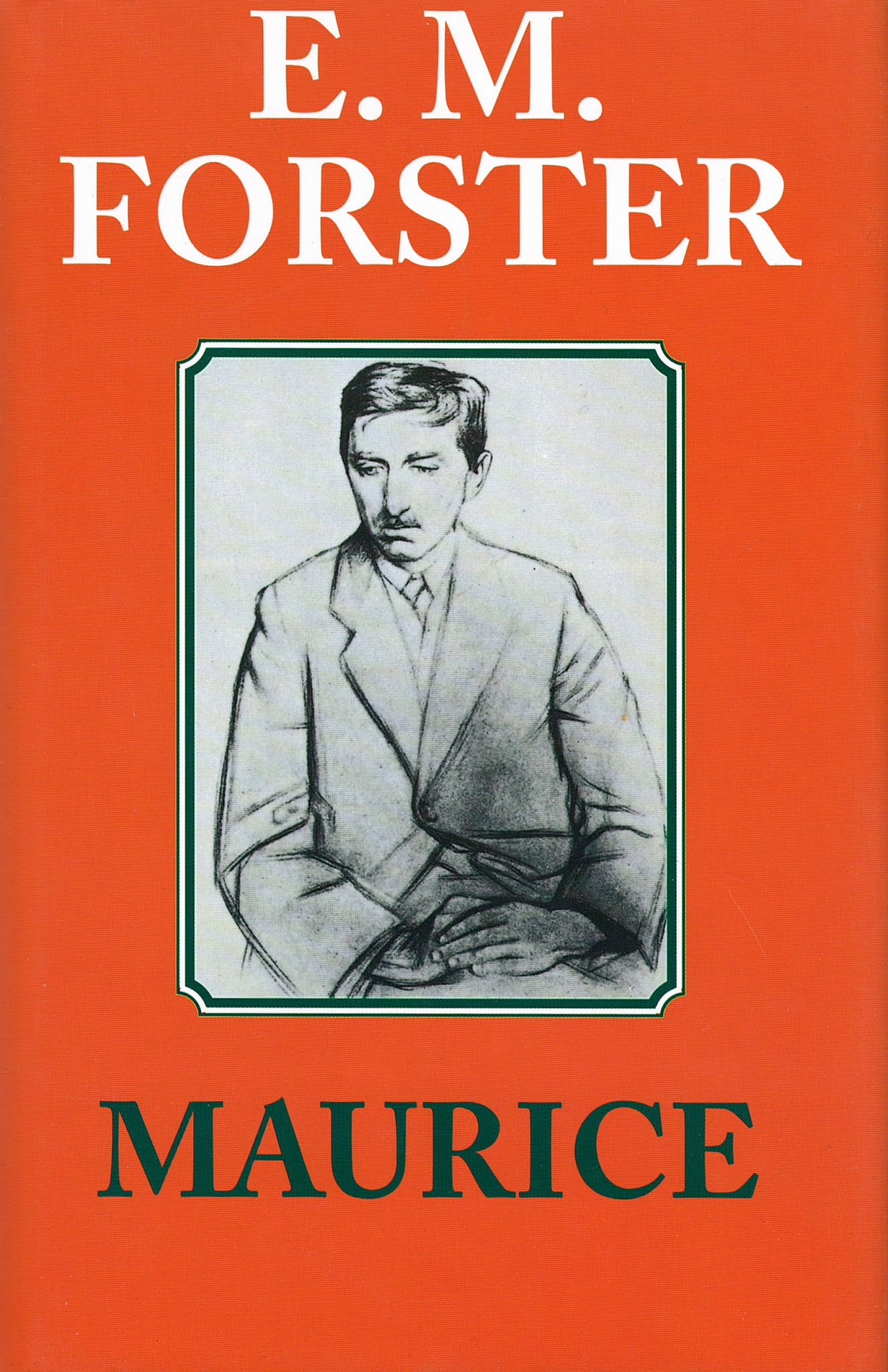
Maurice by E. M. Forster ; Abinger Edition : 5 ; London : André Deutsch, 1999
Abinger Edition : 5
London : André Deutsch, 1999
1999 saw the publication of the Abinger edition of Maurice, which like all Forster titles in the series, presents the work based on all manuscripts and notes available on a particular work. The 1971 edition of Maurice uses the 1959 manuscript as its core with minor changes to deal with issues of consistency and punctuation. The Abinger edition uses the manuscripts from 1914, two different versions of the 1932 manuscript and two versions of the 1959 manuscript to present a version of the novel that reads more smoothly. As well, notes are provided that discuss and show the additions and subtractions from the text through time. 

A key piece from the original 1914 manuscript that was dropped early by Forster is an epilogue that gives the reader a window into Maurice and Alec's life five years on. When Maurice's sister, Kitty, runs into him, he is working with Alec as a woodsman. The chapter, written primarily from Kitty's point of view, makes it clear that Maurice's choice has left himself and his family in disgrace and that he is no longer in contact with them. While he and Alec seem as committed to one another as ever, their life is not easy. After running into Kitty, they decide they must move on. It is interesting to see that Forster was realistic about what the future might hold for his characters, but by eliminating the epilogue he gave the reader a more uplifting ending with possibilities for Maurice and Alec.

One of the important things about reading classics of gay literature is a consideration of gay legacy and understanding the history of those that came before. Maurice is a beautiful example of acknowledging the long history of gay men and culture through the use of classics of Greek literature within the storyline, showing Clive and Maurice trying to understand themselves and their feelings by knowing their history. As well, the basis of the novel grew out of of the relationship that Forster saw between Edward Carpenter and his working-class partner George Merrill. It is the honoring of gay men who came before while passing the torch to the next generation. 


Bibliographies & Ratings II: Gunn (Britain 11b)

Wednesday, April 21, 2021

Murder by Jared French

Murder (1942) Jared French (American, 1905-1988) Egg tempera on plaster coated panel 43.18 x 36.83 cm The Pennsylvania Academy of the Fine Arts
Murder (1942)
Jared French (American, 1905-1988)
Egg tempera on plaster coated panel
43.18 x 36.83 cm
The Pennsylvania Academy of the Fine Arts

Tuesday, April 6, 2021

The End of My Life by Vance Bourjaily

The End of My Life by Vance Bourjaily ; New York : Scribner's, 1947
New York : Scribner's, 1947
Published the same year as John Horne Burns' The Gallery, The End of My Life is also a novel about World War II and its effects on the men who served. Bourjaily's narrative is structured around four young men who aren't in the military but instead join up with an ambulance crew for the British military in Syria and Lebanon before the U.S. had joined the war. Each has his own reasons for serving, running toward something, running away from something, or simply trying to understand how to live in a world that is seemingly falling apart.

Freak is the most 'normal guy' of the bunch and has joined the ambulance crew to do his part after failing to pass the medical exam for entry into the military. Benny, a Jewish communist understands the importance of the war and what it means for the future of the world, but particularly the future of the Jewish people and himself. Rod is a night club musician who doesn't stay in one place for long and doesn't seem to make lasting connections.  Finally, Skinner Galt is the main character through whose eyes we see the action of the novel and feel the struggle of the characters.

Homosexuality is frankly acknowledged by all of the characters and it is understood that there are plenty of gay men in the military. Although it happens away from the action of the novel, Rod's relationship with one of the gay men in the ambulance outfit is offered in all its complexity. Rod isn't comfortable with what it means for him, particularly what it means for his mental health but at the same time he describes his feelings as love. So while the characters follow the gayness as illness paradigm of the time, they are also allowing for the relationship to be based on an emotional connection, not simply a physical or sexual one.

At its core, this novel is an exploration of what it means to be human. We like to think that we are all acting as individuals so what we do only affects ourselves. We don't like to acknowledge that our collective actions reflect on humanity as a whole. In Skinner's case, he doesn't get to separate himself from the consequences of war just because he drove an ambulance instead of firing a gun. As Benny points out toward the end of the novel, no human being is an exception to humanity.


Bibliographies & Ratings: Cory (IV); Garde (P, 117***); Mattachine Review (IV); Young (3259*)

Bibliographies & Ratings II: Gunn (American 37b); Levin (69); Slide (7)


Thursday, March 25, 2021

Rough Trade by Arthur Lett-Haines

Rough Trade (1935) Arthur Lett-Haines (English, 1894-1978) Watercolor and crayon on paper 26.7 x 21.6 cm.
Rough Trade (1935)
Arthur Lett-Haines (English, 1894-1978)
Watercolor and crayon on paper
26.7 x 21.6 cm.


Tuesday, March 9, 2021

Sojourn Among Shadows by Murrell Edmunds

Sojourn Among Shadows by Murrell Edmunds ; Caldwell, ID : Caxton, 1936
Caldwell, ID : Caxton, 1936
Sojourn Among Shadows opens with a young man in a park listening to live music. He is soon joined by a stranger, an older man, who eventually gets his attention and has a story to tell. He claims the story is not about himself, but he uses the first person just for the ease of the telling. They meet in the park over the course of several days as he relays his story. 

The story's young protagonist grows up the son of a preacher who is less than godly in his behavior. His mother dies and he is rescued from his abusive father by his uncle, Tom. Uncle Tom feels it important to get him away from his father but doesn't see himself as a person fit for him to be with. The boy's father often argued with his wife regarding Uncle Tom's 'degeneracy' and she would point out that it was his god that had created Uncle Tom. Hoping to protect the young man from his 'vagabond life', Uncle Tom places him with a family only to later learn that he has seen the truth of the world even in isolation.

The novel is complicated by the author's decision not to provide names for most of the characters. Some characters are eventually named, but names are offered as an aside after the bulk of the action involving them has passed. The only character that from the start is given a name is Uncle Tom, and this is maybe not completely surprising. Edmunds tackled controversial issues in his life and in his writings, having been a strong voice against Jim Crow laws. Written in the form of a fable, this novel, while not a true defense of homosexuality, does argue all humans are born as their creator intended. Using the name Uncle Tom for one of his characters and also making that character gay may be a way of showing a connection between the challenges faced by both blacks and gays.


Thursday, February 18, 2021

Saturday, February 6, 2021

Bibliographies of Gay Literature II

In 2014, I posted about a handful of early 20th century bibliographies of gay literature, covering novels, short stories, plays and in some cases biography and biographical fiction. Those publications not only tried to provide a list of titles but also described them through various ratings systems to declare the extent of the gay content and/or the nature of the content. A number of other bibliographies that are more descriptive in nature, and focus exclusively on the novel have also been published and are presented here. A single work focused entirely on plays has also been included as it can be thought of as the third part in a mammoth undertaking covering British Commonwealth and American novels and plays by Drewey Wayne Gunn.  This batch of bibliographies focus more on thumbnail sketches, and in some cases more lengthy analysis, of the storyline as opposed to boiling things down to a single rating. Using resources from both groups of bibliographies together can provide a more complete picture of an individual novel or play.


Playing the Game : The Homosexual Novel in America by Roger Austen Indianapolis : Bobbs-Merrill, 1977
Indianapolis : Bobbs-Merrill, 1977
Playing the Game : The Homosexual Novel in America

Austen, Roger
Indianapolis : Bobbs-Merrill, 1977

Austen provides information about the publications he covers in a prose style as opposed to a list. Structured into chapters covering chronological segments of history, novel storylines are discussed and played off of one another. 

•  The Dim Past (1870-1929)
•  The Thirties
•  The Forties
•  The Fifties
•  Since 1960

The Selected Bibliography (1870-1965) offered at the end of the text provides a quick list of the titles covered in the preceding chapters. 


The Gay Novel in America by James Levin New York: Garland Publishing, 1991
New York : Garland, 1991
The Gay Novel in America

Levin, James
New York: Garland Publishing, 1991

Structurally, Levin's The Gay Novel in America owes much to Austen's 1977 work. Also structured into prose chapters covering segments of literary history, but more fully fleshing out the earliest literature, Levin also pushes forward to the 1980s.

•  Locked in Victoria's Closet
•  Butterflies, Pansies, Twilight Men, and Strange Brothers
    —The Novel Between the Wars
•  Postwar Permissiveness: 1946-1950
•  Homosexuality in the Freudian Fifties
•  The Sixties: Time of Transition
•  Politics, Power, and Pride
•  The Enigmatic Eighties

The Notes section at the end of each chapter also serves as a quick list of titles discussed within the chapter.


Lost Gay Novels : A Reference Guide to Fifty Works from the First Half of the Twentieth Century by Anthony Slide New York : Harrington Park Press, 2003
New York : Harrington Park Press, 2003
Lost Gay Novels : A Reference Guide to Fifty Works from the First Half of the Twentieth Century
Slide, Anthony
New York : Harrington Park Press, 2003

Slide offers a narrower list of titles, limiting the bibliography to fifty, but provides a lengthy entry of 3-5 pages for each title. Major storylines and themes are discussed as well as providing biographical information on the authors. Titles are listed in alphabetical order by author but an appendix also provides the titles and authors in chronological order. Some of the commentary on the relative literary quality is a bit harsh towards the works discussed, but the value of the remaining content is not diminished. One can certainly argue how truly lost some of these titles are but highlighting those that may be known to some of us is of benefit to all who are interested in gay novels from the early 20th century.


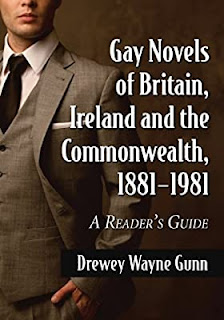
Gay Novels of Britain, Ireland and the Commonwealth, 1881-1981 : A Reader's Guide by Drewey Wayne Gunn Jefferson, NC : McFarland, 2014
Jefferson, NC : McFarland, 2014
Gay Novels of Britain, Ireland and the Commonwealth, 1881-1981 : A Reader's Guide
Gunn, Drewey Wayne
Jefferson, NC : McFarland, 2014

Gunn's British Commonwealth bibliography, covering one hundred years, consists of numbered entries arranged in chronological order from 1881 to 1981, marking the end of the pre-AIDS era.  Many entries cover multiple titles and are grouped in one of two ways ; multiple titles published within a short time-frame with a common element or theme or multiple titles by the same author covering a longer time frame. Short biographical entries are provided for many authors. A postscript provides a general sketch of politics and publishing after 1981.


Gay American Novels, 1870-1970 : A Reader's Guide by Drewey Wayne Gunn Jefferson, NC : McFarland, 2016
Jefferson, NC : McFarland, 2016
Gay American Novels, 1870-1970 : A Reader's Guide
Gunn, Drewey Wayne
Jefferson, NC : McFarland, 2016

Gunn's American bibliography, covering one hundred years, consists of numbered entries arranged in chronological order from 1870 to 1970, marking the end of the pre-Stonewall era.  Many entries cover multiple titles and are grouped in one of two ways ; multiple titles published within a short time-frame with a common element or theme or multiple titles by the same author covering a longer time frame. Short biographical entries are provided for many authors. A postscript provides a sketch of major works from 1971-1981, ending where his British Commonwealth bibliography does, at the end of the pre-AIDS era.


For the Gay Stage : A Guide to 456 Plays, Aristophanes to Peter Gill by Drewey Wayne Gunn Jefferson, NC : McFarland, 2017
Jefferson, NC : McFarland, 2017
For the Gay Stage : A Guide to 456 Plays, Aristophanes to Peter Gill
Gunn, Drewey Wayne
Jefferson, NC : McFarland, 2017

Gunn's bibliography of plays covers a the huge time period from the 5th century BCE through 2014. Consistent with his earlier bibliographies for British Commonwealth and American novels, numbered entries are arranged in chronological order and provide the play's storyline and information about production history.  Play entries have been grouped into the following chapters opening with a brief list of major gay historical or cultural events from the period. 

•  Pre-Modern, 5th c. BCE-18th c. CE
•  Early Modern, 1881-1943
•  Post-World War II, 1945-1969
•  Post-Stonewall, 1970-1981
•  AIDS, 1982-1989
•  Early Nineties, 1990-1994
•  Pre-Millennium, 1995-2000
•  Early Contemporary, 2001-2007
•  Recent Contemporary, 2008-2014